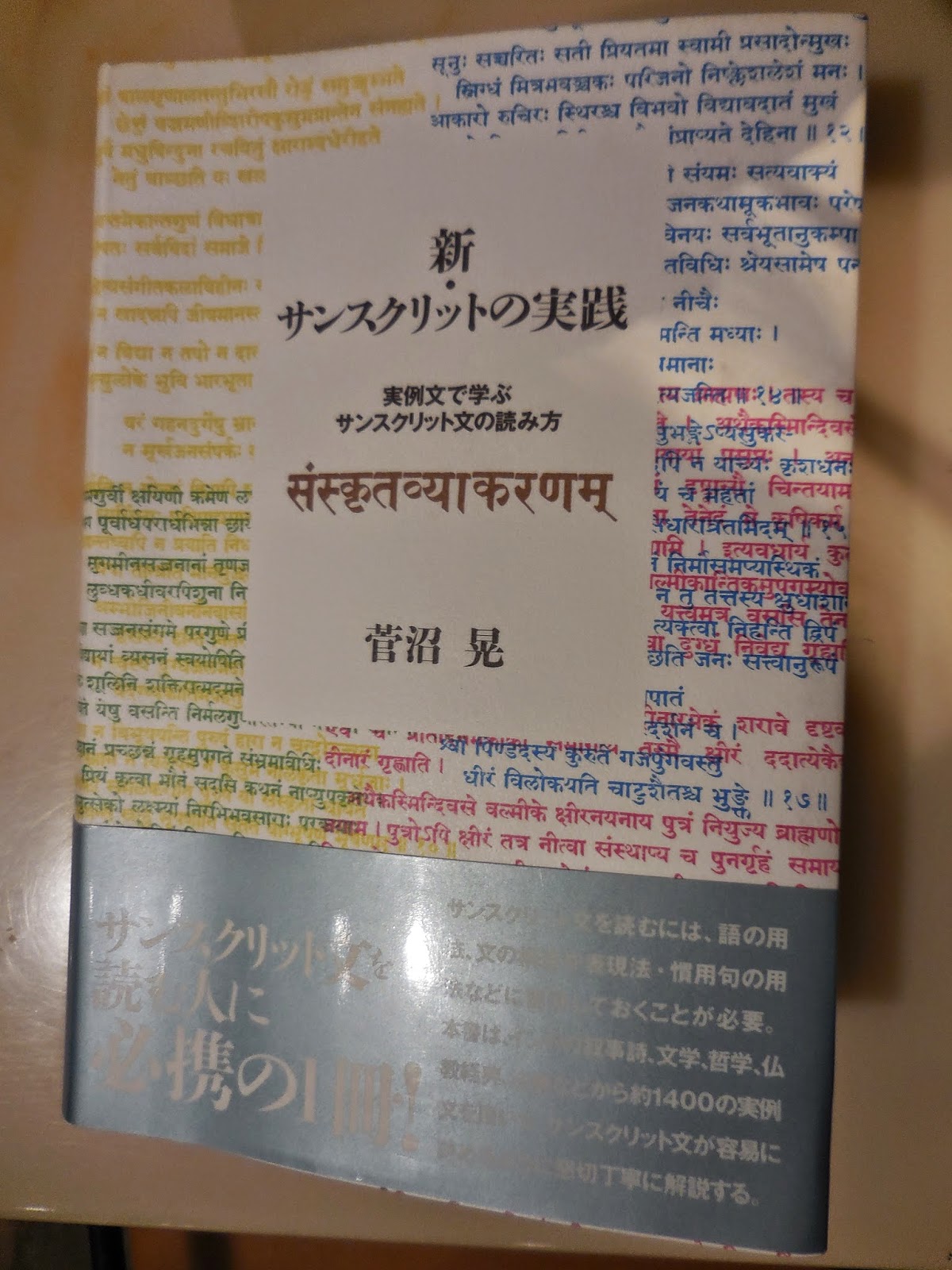
It took me a while, but I finally finished reading “Miracle of the Japanese Language” by Yamaguchi Yoji. It was a thin book, but made me think a lot. I didn’t want to finish it. I’m fascinated to find out how ancient Japanese learned and digested foreign words. My imagination goes back and forth, traveling in time. Yes, I see avatars in my head.

One of them is Kûkai (774-835). He was a priest who went to China to study Buddhism. What fascinated me was that, according to the book, he studied Sanskrit without any access to Sanskrit speaking persons or documents. He must have gone through waves of culture shocks. At the time, Japan had only Chinese documents, but the quantity seemed equal to that of early Tang Dynasty. Kûkai probably transported on his back a heavy load of scrolls like a day laborer. At the time, Japanese writing system was not yet invented. Japanese elites then only knew Chinese characters.
Back in Japan, Kûkai must have felt doubts sitting before many great Chinese scrolls. He searched Sanskrit words reading Chinese sutras. After all, Chinese Buddhist sutras were originally translated from Sanskrit. The more he studied, the more he wanted to get to the source language. So he read the Chinese characters on and on and on, and backward and forward using numerous possibilities in sound and meaning. There were no television sets or computers. He didn’t go shopping or go to the kitchen to cook. He read and read and read. In the afternoon, he strolled away from his temple thinking, “What is the most important thing?” He didn’t have an answer. So he returned to the temple and read aloud on and on and on again.
As an ordinary person, Kûkai believed in the soul of words as well as every living thing including rocks and stones. This strong native belief eventually became connected with a Sanskrit word, dhaaran (陀羅尼). He probably recited a long sutra over and over again in order to get near the truth. Those documents contained no syntax or spaces, but showed characters after characters. Each character and combination of characters shows multiple meanings, and each sentence could be interpreted also in multiple ways. This is still true today. And I hear in “dhaaran,” Japanese mimic words daradara or daaradara. Daradara or daaradara means “on and on seemingly without purpose.” Dhaaran is opposite of Shingon. SHINGON 真言 means true words. Posterity calls his teaching Shingon.

Reizei-in library housed many Chinese documents. It was burned down to ashes 40 years after Kûkai died. I don’t know if it was an accident or a politically motivated incident. 20 years after the incident, in 894, Japanese court cancelled the Tang exchange students program. Tang Dynasty and their Buddhism had been in decline.
I wonder if some Sanskrit documents were in that library. If Sanskrit documents were there, what Kûkai refused to show to another priest, Saicho, could be Sanskrit documents.
I wrote this before in Red Room before, but 1200 years ago, Kûkai refused to show his document to Saicho. Both sects weren’t officially recomciled, so on June 15, 2009, each leader of the two sects met and shook each other’s hands. Isn’t that something? Anyway, Kûkai must have ordered his students to make many copies.
Those two priests competed for good. They both wanted to save people from misery with their words. “No matter how many books we import and read, if we cannot digest, communicate, and apply on our daily life, what good does it do?” I think they thought like that.
The journey of creating the Japanese language is fascinating. I’m sure I’ll learn more about it. By the way, I connected Avatar to Sanskrit in other way beside the fact nobody seemed to know. Abataあばたmeans pockmarks. I looked it up and sure enough it is a Sanskrit word again. But this time, it says abata came from “arbuda.” The Sanskrit word,“Arbuda” means pockmarks also. “Ava” of avatar means “descent.” Pockmarks are depressed, so I think maybe those two words were connected long before the ancient time.

Anyway, the sound of some words hits my central nervous system and makes foreign music. And we don’t have v sound. Instead of v, we use b. Also, we call Abata’s ba impure sound. When I quiet my mind and listen to words, I feel a bit odd hearing ba sound. This seems discriminating, but we call it impure sound. Impure is relative though. And foreign words have been exceptions to the rule. I’m talking about real down-to-earth yamato words like Anglo-Saxon words to English.
So Japanese have named dirty things with impure sounds starting b, g, d, and z. For instance, gomi means trash, and gomi is a yamato word. I do not hear any girl names starting with those sounds. Some women have that sound in the middle of their first name like Nagako. Nagako was the name of Empress Michiko’s mother in law. So there are exceptions. But I cannot deny thinking that why anyone named her that name. “Ga” sounds abrasive. Gaagaagaa means a mimic word for a loud motor sound. I felt sorry for the former empress.
This similar phenomenon was confirmed when I read Suzuki Takao’s books. He talked about the impure sounds of Japanese language. Maybe later on, I can write more about it. It is probably hilarious and puzzling to non-Japanese. I’ve taken for granted, but it is very interesting because I can’t even explain why. I just feel it, and it comes from the root of our language.