Showing posts with label radiation. Show all posts

Saturday, April 25, 2015

I'm sorry but this is serious and we all need to know.

About the Fukushima power plant, please take your time to listen to Koide Hiroaki, a nuclear researcher and a former assistant professor of Kyoto University.

http://www.videonews.com/press-club/150425-koide/

Saturday, June 11, 2011

List of Japan's Radioactivity


I hope this helps.  On Facebook, Kyoto Journal is having a good discussion on Shizuoka tea.
So, I investigated related sites, and the following site, I found most of information including tea: http://atmc.jp/

You can compare with the US standards which are in rightmost columns.

Related to tea, I found the following three sites.

1. fresh tea leaf (we do not consume fresh leaf.)
http://atmc.jp/food/?s=i131&q=59dda&a=&d=21

2. dried tea leaves (we do not eat.)
http://atmc.jp/food/?s=i131&q=80a54&a=&d=21

3. tea drink (this is relevant.)
http://atmc.jp/food/?s=i131&q=5efae&a=&d=21


About high or low radiation, it is relative. On this subject, please read my blog, "High or Low."
http://keiko-amano.blogspot.com/2011/04/high-or-low.html
I don't work for the tea industry nor the Japanese government.

Monday, April 18, 2011

Low and Long


So, we know that exposing to enormously high radiation all at once or having accumulated over 100 millisieverts will increase the cancer risk. But what would happen if we were exposed to low radiation for a long period?


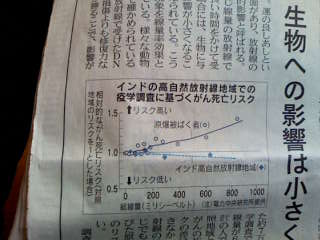
Nikkei newspaper of April 17 showed the above graph. The title is “The risk of cancer death based on an epidemiological research in the high radiation area in India.”  I googled some erroneous spelling, but luckily, I found the following.
http://www.ncbi.nlm.nih.gov/pubmed/19066487

On the graph, the left vertical line shows risk, and in this case, the risk is set to 1. The bottom horizontal line shows the value in millisieverts. The longer they are exposed with low level of radiation, the risk is going down. Isn’t that interesting? I heard some part of Brazil and Iran has high background radiation, so I guess the situation must be similar. In the above web article, I found the words, terrestrial gamma radiation. Terrestrial sounds mysterious. It reminds of Ashok’s blog on Paspermia and Pansmeria. What we have under our lands are scary like faults, plates, and radioactive mineral but also fascinating.

According to Nikkei, in Karunagappally, Kerala, India, radioactive minerals are scattered in the area, and the average radiation there is 5 to 10 times more than the world average. The residents are exposed to the natural radiation of 10 to 20 millisieverts a year. In 2009, a study on 70,000 residents was conducted. The result was even the people who had accumulated over 600 millisieverts showed no evidence  in the difference on risk when compared with a control group. For the same amount of radiation, if our exposure took a long period, then the effect on living thing would be smaller.

In recent weeks, I’ve gained quite many readers from Ukraine. I’m glad to see my blog statistic map turn green there. Now I know exactly where Ukraine is in the world map. I just want to say that I hear often Japanese scientists refer to what they’ve learned from the Chernobyl accident. Because the experts were able to accomplish many studies in Ukraine, the Japanese government quickly notified us about radiation when rained and the danger of pipe water for babies. They distributed bottled water to affected families. I appreciate the knowledge.


Sunday, April 17, 2011

Calculating Risk

An Old and Prized Cherry Tree Behind Gumyoji Kannon


Below is an excerpt from May issue of Bungeishinju magazine. The title of this interview-styled article is “The Truth Is It Takes A Year,” and the subtitle is “Erroneous Reports on Radiation.”


Interviewer: Koichi Okamoto, specialized in Crisis Psychology, Professor at Toyo-Eiwa Women College, a specialist member of Nuclear Energy Safety Committee and Nuclear Energy Committee

Interviewee: Masayori Ishikawa, Professor of the Graduate School of Hokkaido University
Studied and worked at Kyoto University Nuclear Reactors Research Center, Tokyo University Nuclear Power Research General Center, Hokkaido Hospital,


The Petals of the Cherry Blossoms 


On page 209, this is what the interviewee said.


“To evaluate the amount of radiation, we have to add how much exposure we collected throughout our lifetime, not just in days.”


A friend of mine has recently told me that after the Hiroshima bomb, the radiation fall out onto the Kanto region--Tokyo and Yokohama included, was 10,000 times more than the previous norm. I didn’t know that. My parent died without knowing it.


“This is based on the current statistics. If our accumulated amount passed 100 mili sieverts, and if we added more, per 1000 mili sievert (1 siervert), the cancer rate would possibly go up 5 %. Therefore, if a person were exposed to 100 mili sieverts so far in her or his life, and also the probability of that person to afflict with a cancer were 50 %, then the rate becomes 50.5 %.

Today, one person out of two gets cancer, and one out of three dies by cancer. Being aware of these facts and the accumulated amount of our own radiation exposure and risks, we can choose the way we live.”


So far, I know the Japanese average is 1.45 mili sierverts a year. The Hiroshima and Nagasaki bombs happened before I was born. My mother and aunt must have exposed to the 10,000-times-over-the-norm radiation, and the descendants like us are I’m sure affected. I moved to the U.S. in 1970. So, I want to know the U.S. average by state, city, and town. My mother died of liver cancer at age 76, but my aunt moved to the U.S. around 1955, and she is 87 and has dementia, but as far as I know, she doesn’t have cancer.

I hope this helps.

Wednesday, April 6, 2011

High or Low


natural radiation map  April 3rd


Thank goodness the leakage of high radiation water at last stopped. On high or low, I’ve learned that radiation rates depend on variables, but that leak from the pit near the Reactor two was way too high.


At Fukushima Daiichi, operators have been dumping their accumulated low radiation water into the ocean since yesterday. They call it low because apparently France and Britain have been dumping their processed radiation water of similar rate. I didn’t know that. Nobody has given us the comparison data. I read it in Nikkei newspaper yesterday. It was not on the first page. I’d like to know the rate from each country such as Japan and the U.S. We all must be dumping the processed water tainted with radiation.

By reading the New York Times, I haven’t seen much explanation about high or low on radiation. Their articles tend to report on high, higher, and highest on radiation in Fukushima. An article on the NY Times on April 1st still stresses on expanding the danger zone to 80 km radius. The article focuses on one higher radiation spot. I wondered if the article was a reprint for a moment.

Daily, Japanese newspapers report on radiation rates by region. They are low. See the photos. Again, Japanese announcers do not compare much with foreign countries. They would say, “It has gone up slightly,” or “it went down to normal rate.” The rates of natural radiation in Japan are very small compared with the rates in foreign countries. I watched one Japanese program in which a Japanese expert showed the average radiation of the world as 0.5. I think the unit is micro sievert. That’s ten times higher than the Japan’s average. I couldn’t believe it. In another television program, I saw the average of the U.S. natural radiation was 0.4. In Yokohama, it’s about 0.04. 0.04 is the Japan’s average.

Right now, Tokyo’s average is double the Yokohama rate, but no need to be alarmed when we compare it with the world average. That’s why people say, “it’s high or higher than normal, but it won’t affect on our health, it’s minimal.” According to the numbers on the photo, that’s true. Government officials and announcers are telling own citizens, not to the citizens of other country.

About the food contaminated with radiation, one Japanese expert said that if we ate, although we will never do that on purpose, such spinach and drink such water and milk for one year, the amount of radiation we take in will be similar amount as we might receive if we simply live in a foreign country with the average radiation. You can imagine why they say that. But I assure you that the opinion was directed to calm the Japanese public. The expert did not speak in an arrogant way, and no one would like to compare with foreign countries and say we are better in any way, especially at the time of spilling HIGH radiation water into the ocean.

I can see why Japanese government officials don’t talk much comparing with foreign countries although they are doing it now in a very slow and delicate way. They don’t want to create more harm than they already have. They don’t want to boast the good thing Japan has enjoyed all these years in face of this gigantic nuclear radiation problem.

I don’t know the reason why the natural radiation Japan receives is so low compared to the average in the world. I guess it is just the way it is. It is interesting though that China is very close to Japan, but their average is 0.54.

Further, even in Japan, our natural radiation rates vary by region. I heard that Kansai area is double the Kanto area. Osaka and Kyoto are in Kansai. Tokyo and Yokohama are in Kanto. Separately, also Ibaragi is in Kanto, not the northeast. One of the reports I read in Huffington, Ibaragi was the part of the northeast.

But how the radioactive materials are spreading if they are? I don’t understand their spread with the relationship to the natural radiation map with numbers. Asahi newspaper listed the following site but it said it isn’t detail. It also said the machine broke after giving an output once. www.jma.go.jp/jma/kokusai/kokusai_eer.html IAEA also is collecting data for making global forecasts. I wonder if the system was used before and how accurate it has been. I see many sites, but I just need one easy map to see and the info. to be correct. That is my concern.

About the design of Fukushima Daiichi Nuclear reactors, it was confirmed that it was old. No surprise there. Toshiba and Hitachi tried to imitate GE’s design to learn how to build reactors. The emergency generators that failed should have been housed in more secure place. The CEO of GE made his visit to Japan after three weeks from the accident. I haven’t heard much about whose responsibility the design is, but I sense a little bit what’s going on. The language barrier must be great. That’s my hunch. I think imitating is a good way to learn as junior engineers, but to build nuclear reactors, imitating alone is enough. We have to know what we are doing from core and include all the error routines and seek expert opinions in each category and synchronize all the knowledge. I saw a photo of spaghetti wiring plus tube looking things overhead that a former nuclear reactor engineer has shown. I used to watch customer engineers work under the floor of mainframe computers, but it is much worse. It looked like a giant mess.

Saturday, March 26, 2011

Conflicts


1.  A while back, Edano, chief cabinet secretary, ordered the people in the radius between 20-30 kilometers to remain indoors. But criticisms arose, of course, because not all the survivors there could receive relief supplies. Not everyone live in the shelters. Some still live in their homes. They have to get to a shelter daily to receive supplies.


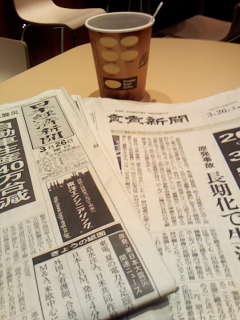
2.  Since the 9.0 hit on March 11th, some airlines haven’t landed in Narita airport. The U.S. pledged a return flight to 9000 Americans. On 24th, according to Nikkei newspaper, French ambassador said during his interview that he did not order his citizens to evacuate, but some of them and companies left Tokyo and the surrounding areas right after the earthquake hit. He said such behavior was inappropriate, and he wanted to apologize to Japanese people.

Edano has said he understood such actions. He said he would do the same if he were in similar situation. I feel the same, and I mean it, too. But, when I read the above apology by French ambassador, I appreciated it.


3.  If we received little information from Tepco (Tokyo Electric company) or the government, it might create fear in us. So, newspapers reporters and television announcers have been repeatedly reciting the rate of radiation for various items so that correct information would calm us down. If I see such news once and be assured of safety, I think it’s good. But if I see a high rate again and again, it isn’t. The thing is, if we worry, we tend to watch more. But again, I appreciate correct information.

According to Asahi newspaper on 25th, after Chernobyl nuclear blast, only thyroid cancer rate went up, but no other illness has increased. It said that the increase in thyroid cancer at Chernobyl came from those babies who drank contaminated milk over a period after the explosion. If that were true, why hasn’t the authority explained to us this important fact earlier? Does everyone know this except me?

Also, I’ve learned that, according to Nikkei newspaper on March 26, the voluntary restraint set for radiation by Japan’s government is 5 milisierbert. But it is planning to raise the amount to 10 milisierbet according to International Control of Radioactive Protection. ICRP raised the value to 10 milisierbert in 1992, and at that time, they decided that they would increase further if alternative products were unavailable. Hmm. I didn’t know that is how it works. Again, why hasn’t the authority explained this important fact in detail before? I did hear before that Japan has stringent regulations, but I wish I was confirmed on this fact backed with numbers.


4. Page 2 of March 24th Ashahi newspaper: A 64 year old man who lives within 40 km radius to the nuclear plant spoke angrily, “The government said my area is safe, but the city workers said as if it were very dangerous. Which is it? The rumor spread. People think the entire city could be in danger. Nobody will deliver goods to the town where people are leaving.”


That’s all today.

Tuesday, March 15, 2011

Nuclear Reactors

March 15, 2011 
Close to Minami Elementary School, Yokohama
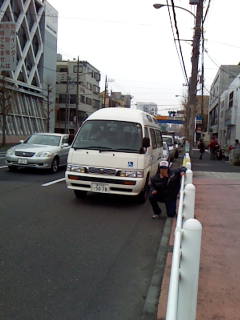
Cars line up before a gas station.

March 16, 2011 (My current date on my laptop is correct, but I still receive errors when I try to sync.)


Yesterday morning, there was an explosion at the First Fukushima Nuclear Reactor site. Tokyo Denryoku (The power company for the northeast and the kanto plain) reported that the suppression pool area of the second nuclear reactor vessel had some damage. Also, the fourth reactor had started a fire before the second reactor’s problem. And the radiation amount was shooting up. The news was scariest of all.

The first and the third reactors already had explosions, but they came from the outer structures of the vessels, not from the core structures. But, still I was scare watching the news. All these reports are clearly very bad news. Winds are blowing, and 500,000 people or so are closely affected, and the rest of Japan and other countries like China and Korea will be affected if the situation doesn’t improve. Radiation is our main concern.

Japan asked the U.S. for help to neutralize reactors. I also heard the water supply trucks were sent to the Fukushima reactor site, filled with sea water. Japanese Government stepped in to remove communication gaps with Tokyo Denryoku. PM Kan is said to be extremely dissatisfied when he received no report for one hour from Tokyo Denryoku while the television kept reporting about the second reactor’s incident.

In the meantime, we need to save electricity. As I mentioned in the previous blog, Tokyo Denryoku divided their supply area into five groups. For some reason, my area appears in both Group 3 and Group 5. The day before yesterday, I expected no power after 5 pm to 7 pm, and yesterday morning, from 6:20 am to 10 am, but it didn’t actually happen. But yesterday, while I was having my lunch at a local noodle shop, the power went down. The shop serves the best noodle, but I will blog about it some other time.

Before I entered the shop, I saw a long line of cars in front of a gas station. Both sides of the main Kamakura Kaido Boulevard have a gas station. When I paid and went out, there were no cars in both stations. The sign, “Closed due to gas shortage. The schedule for tomorrow is undecided.”

The local swimming club near my home is usually open from early morning till late at night, but they show a sign, “Closed from Tuesday to Friday.” I was surprised that a local hot springs called Super Sento was open. I was naked lying down on a running warm water surface, watching the dark sky when magnitude 6.4 hit. I stood up with the young woman next to me. Six or seven women came out of two hot tubs nearby. We didn’t want to be stranded in a cold and dark night in our birthday suits, so we walked into the building. After I dressed and walked out of the locker room, I found all the foot massage machines near the lobby were gone. A worker said they were sent for repairs. I thought it odd. Did all four foot massage machines become out of order at the same time? Then, I passed the line of five or six body massage chairs. One showed a sign, out of order. The second had the same sign. I checked them all. All were out of order. Oh, I thought. That was the reason why a spokesman on television recommended to turning off breakers if possible.

Right now, my place is affected by the power cuts. I left my refrigerator plugged in, but the rest, I unplugged all. I’ve gone to a convenience store and bought a package of masks just in case. I’ll go buy a few more items if stores are open.

The other side of the same road as above photo.
The right top corner is another gas station and cars are lined up along the street.


Closed for the day.
Tomorrow's schedule is undecided. 


My area is both Group 3 and 5.
The top line is March 15th.  On 16th, today, we might get our power cuts three times if the situation gets worst.