Showing posts with label tsunami. Show all posts
Monday, May 9, 2011
The Systems Disaster
The US economy must be picking up. I received some email from US recruiters. There must be a demand for infrastructure and disaster recovery experts there. This is a coincident because I’ve been following up on a secondary disaster following the earthquake and tsunami. The Mizuho Bank’s systems disaster showed up a few days after 3/11.
Mizuho has reported that deposits into two earthquake-relief funds inundated their systems after March 12th but couldn’t handle it. “It” is the problem. We don’t know exactly what it is. The systems started limping afterward, but partially operating systems meant not working at all. The batch window is limited. It must complete by morning. I think the bank couldn’t balance all the accounts before the start of the following day.
This was in the middle of the Disaster. Affected people needed cash. The bank closed all ATMs for three days to recover, but they announced that the users could go to their branch offices and withdraw up to 100000 yen which is about $1200. Guess what? Some users went to their different branch offices and kept withdrawing 100000 yen even though they didn’t have money in their account. Talking of chaos! The problem didn’t come to end until 10 days later.
To compete in the global financial world, Mizuho was created by merging three large banks, Fuji, Daiich-Kangyo, and Kougyo banks. Not two but three banks at the same time. It kept the old accounting systems of former Daiichi-Kangyo Bank, and the up-to-date information systems of the former Fuji Bank. So, the system could handle transactions from all over the world all day and probably almost all night. So, you can imagine the kind of systems projects they had to go through. It must have been very tough, so when I heard of their 2002 system outage, I was sympathetic to their systems programmers. They probably had many sleepless nights. But, that wasn’t the last disaster. They and probably anyone probably never thought of receiving such large number of deposits concurrently without stop. Well, it happened.
A few executives probably have to resign from their posts to take responsibility. For the government, this event has been a good opportunity to go in and investigate the bank’s internal operations closely so that they can make sure the bank cannot fail to pay all the taxes even if their systems collapse.
Labels:
earthquake,
Mizuho Bank,
secondary disaster,
tsunami
Thursday, April 28, 2011
Reply to Luciana
Lu,
I appreciate your comment. My reply ended up very long, so I decided to make a new blog, “Reply to Luciana.”
Iino-san, a Japanese blogger, wrote a few days ago that he attended a lecture on Nuclear Reactor and Radiation set up by Tokyo Institute of Technology. He wrote that Tokyo Electric intentionally made the blasts to avoid the worst melt down. Good or bad is relative, and I’m sure experts worldwide have their opinions. But learning the fact that they thought of the worst case scenario during the crisis peak and acted on it made me feel better.
The president of Tokyo Electric was on his business trip in Nara (near Kyoto) on 3/11. The earthquake happened at 2:46 pm on 3/11. At 3 pm, he tried to go back to Tokyo by car, but the freeway became unavailable because of the earthquakes. He took a train to Nagoya and went to the airport to get on to his company helicopter. But because of the regulation—no private flights after 7 pm, he could not fly. So, by 9:30 pm, the Economy-Industry Ministry made an arrangement for him to fly by a defense force cargo plane. At 11:30 pm, the plane headed to Saitama prefecture (the defense force airports are in different locations), and after 50 minutes on flight, a cabinet minister ordered the pilot to u-turn back. The minister said the flight should be used to send emergency relief items, and the president could take a bullet train. Meanwhile, aftershocks repeated and trains stopped. He returned to Nagoya and next morning at 7 am, he took a helicopter and went to the head office at 10 am.
This critical wasting of time, a breakup of national teamwork, affected the relationship between the company and the government officials. Later that afternoon, PM Kan was waiting for the Tokyo Electric’s updates, watching television. He saw the first blast and became furious at the executives. I had sympathized with PM Kan then. PM Kan is a graduate of Tokyo Institute of Technology, and probably a part of his self-learning, he has been studying about Nuclear Energy. At this time, he was getting pressure from the American consulate and then the President for more information. Exactly what happened in what order, I should wait for a complete detailed report. But there were a lot went on.
About patronizing and omitting, that’s what I want to focus on. I want to know the way it is, so we can learn from it.

I wasn’t paying attention until 3/11, but I’ve never heard anyone won their lawsuit against building nuclear reactor. Maybe, Brazil is different, and I hope it’s different. But I was surprised when I heard this morning that the people of Shiga prefecture won such lawsuit in the past. The judge who made the decision was interviewed. He said there were nights he woke up sweating before he arrived at his final decision. But he did it because of valuable human lives.
Because of Godzilla on my other blog, it reminded me that a Japan Airline’s plane crashed in Japan’s soil and killed over 500 many years ago. A popular singer, Sakamoto Kyu, who sang “Sukiyaki” and an old friend of mine from junior high school died in the crash. I didn’t know exactly what happened to that accident, but when I made a visit to my cousin in Yokohama after the accident, my aunt accused that the U.S. was responsible for the accident. Because I have been living in the U.S. for a long time, it was her way of protesting to the U.S. She said if Japan made the plane, it wouldn’t have happened. I didn’t know what to say. I brought this up because my son was with me on that trip. He had a Godzilla in his hand in one of the photos we took during that visit. It reminded me that that my cousin’s son gave his Godzilla to my son.
Anyway, I didn’t know what to say to my aunt. She was very gentle woman. Because of this disaster, I happened to ask a friend of mine about that crash. She said Japan Airline bought the U.S. plane which already had a problem to begin with. When they called a team of American mechanics to fix, they came, worked, covered it and painted it without being inspected. By the time, Japanese quality control workers came to inspect, it was already covered and painted. What did the Japanese do? They let it go. It’s after the fact, but it was fatal and immoral decision. After the accident, investigators gathered all the debris including knots the mechanics used and found out the team of mechanics did shoddy jobs which caused the accident. That’s what I heard.
This disaster issue has gone up to highly sensitive level of the Japan-U.S. relationship. My utmost interest all my life is how prejudice in us ever forms. I mean any kind of prejudice not excluding race. My premise is that the root of prejudice comes from no reason at all except ignorance. That’s what I think.
With that in mind, about the fight a former GE engineer had with his superiors on the safety issue of Mark I nuclear reactor, they are both Americans. During the week of 3/11, Tokyo Electric withheld their information from PM Kan, they are both Japanese. They are all educated people. No one wanted to destroy own or other countries. But if another worse situation happened, these human problems could lead to a disaster of unknown proportion. We cannot stop tsunami and earthquakes, but we can go over these critical human problems and correct and learn from them. Those problems must come from some kind of ignorance, (I hate to include the word, moral, because it’s such a judgmental word and can’t do much with it) because no matter how educated we become, we have the biggest room for improvement. What do you think?
Labels:
disaster,
Early-Stage Reactors,
earthquake,
godzilla,
tsunami
Monday, April 25, 2011
"Mark I" Reactors
This is an excerpt from an April 24th article appeared on Asahi newspaper. It was written by Toshihiro Yamanaka, chief of the Asahi Newspaper New York bureau.
Fukushima Daiichi reactors No.1 through No. 4 are called Mark I which was made by GE in 60s. Yamanaka captured the news that once there was a furious debate within GE about the safety issues on Mark I. It was in 70s. I will translate and summarize one of two interviews he has reported.
Dale Bridenbau, 79 year old, started to work at GE in 1953. It was the year President Eisenhower pitched the usage of nuclear power for peace at an UN conference. Bridenbau worked as an expert on the safety inspection and travelled to Switzerland, India, Italy, and Japan. In Japan, he made visits to Suruga and Fukushima. He said,
“Of course, the Fukushima accident was caused by the earthquake followed by tsunami. It wasn’t that Mark I self-destroyed itself. But, if I pleaded louder for its improvement at the time, it could have avoided that serious situation. That leaves me regret as an early-stage developer.”
1975 was the year that Mr. Bridenbau and his superior fought on a safety issue. As the result of the Mark III development and tests, he discovered the weakness in the containment vessel of Mark I. If an out-of-ordinary event occurred, and that caused the cooling system to malfunction, then the containment vessel cannot withstand the inner pressure and will be damaged. He suffered with this fact. He told his superior,
“What we need to do right away is to study the threshold of the pressure again and improve on it. For that purpose, we need to stop the operation of all the Mark I reactors.”
The opinion of most GE’s employees differed from his. They said, “If we stop the operation, it will be looked at as a serious problem” and “It would make the surrounding residents uneasy.” At the time, 20 Mark I were already operating worldwide. His plead was rejected. He and two young employees left the company on that day of the argument as the result. It was February 1976.
Then and now, GE has maintained that Mark I has been updated and reinforced, so it has no defect.
In early ‘70s, Japan was behind on nuclear technology. Japanese engineers put all their effort in learning by imitating the U.S. technology. Nobody dared to ask hard questions and investigate themselves, I guess. Right now, 32 Mark I exist in the world. We need to confirm if all the Mark I reactors have been followed up with all the appropriate updates and reinforcement GE claims they have. No time to wait.
I read that, so far, the total number of nuclear reactor accidents is 12. The U.S. had 4, France, 2, Germany, Scotland, and Russia, 1, and Japan, 3. We must stop the accident from Japan. Japanese cannot afford to sit and being agreeable anymore.
No matter how bad the situation is, we need to know. How people would react to the news is each person’s responsibility. We still need to know.
Today’s Asahi, I found the following sentence under the article “Question into Japan’s Global Accountability.” “The U.S. Nuclear Regulatory Commission (NRC) has cancelled the partnership with Toshiba to further set up nuclear reactor plants.”
Monday, April 18, 2011
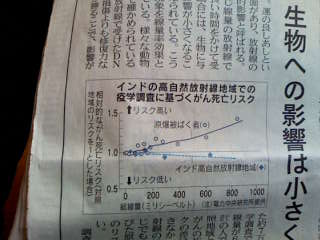
Low and Long
Nikkei newspaper of April 17 showed the above graph. The title is “The risk of cancer death based on an epidemiological research in the high radiation area in India.” I googled some erroneous spelling, but luckily, I found the following.
http://www.ncbi.nlm.nih.gov/pubmed/19066487
On the graph, the left vertical line shows risk, and in this case, the risk is set to 1. The bottom horizontal line shows the value in millisieverts. The longer they are exposed with low level of radiation, the risk is going down. Isn’t that interesting? I heard some part of Brazil and Iran has high background radiation, so I guess the situation must be similar. In the above web article, I found the words, terrestrial gamma radiation. Terrestrial sounds mysterious. It reminds of Ashok’s blog on Paspermia and Pansmeria. What we have under our lands are scary like faults, plates, and radioactive mineral but also fascinating.
According to Nikkei, in Karunagappally, Kerala, India, radioactive minerals are scattered in the area, and the average radiation there is 5 to 10 times more than the world average. The residents are exposed to the natural radiation of 10 to 20 millisieverts a year. In 2009, a study on 70,000 residents was conducted. The result was even the people who had accumulated over 600 millisieverts showed no evidence in the difference on risk when compared with a control group. For the same amount of radiation, if our exposure took a long period, then the effect on living thing would be smaller.
In recent weeks, I’ve gained quite many readers from Ukraine. I’m glad to see my blog statistic map turn green there. Now I know exactly where Ukraine is in the world map. I just want to say that I hear often Japanese scientists refer to what they’ve learned from the Chernobyl accident. Because the experts were able to accomplish many studies in Ukraine, the Japanese government quickly notified us about radiation when rained and the danger of pipe water for babies. They distributed bottled water to affected families. I appreciate the knowledge.
So, we know that exposing to enormously high radiation all at once or having accumulated over 100 millisieverts will increase the cancer risk. But what would happen if we were exposed to low radiation for a long period?
Nikkei newspaper of April 17 showed the above graph. The title is “The risk of cancer death based on an epidemiological research in the high radiation area in India.” I googled some erroneous spelling, but luckily, I found the following.
http://www.ncbi.nlm.nih.gov/pubmed/19066487
On the graph, the left vertical line shows risk, and in this case, the risk is set to 1. The bottom horizontal line shows the value in millisieverts. The longer they are exposed with low level of radiation, the risk is going down. Isn’t that interesting? I heard some part of Brazil and Iran has high background radiation, so I guess the situation must be similar. In the above web article, I found the words, terrestrial gamma radiation. Terrestrial sounds mysterious. It reminds of Ashok’s blog on Paspermia and Pansmeria. What we have under our lands are scary like faults, plates, and radioactive mineral but also fascinating.
According to Nikkei, in Karunagappally, Kerala, India, radioactive minerals are scattered in the area, and the average radiation there is 5 to 10 times more than the world average. The residents are exposed to the natural radiation of 10 to 20 millisieverts a year. In 2009, a study on 70,000 residents was conducted. The result was even the people who had accumulated over 600 millisieverts showed no evidence in the difference on risk when compared with a control group. For the same amount of radiation, if our exposure took a long period, then the effect on living thing would be smaller.
In recent weeks, I’ve gained quite many readers from Ukraine. I’m glad to see my blog statistic map turn green there. Now I know exactly where Ukraine is in the world map. I just want to say that I hear often Japanese scientists refer to what they’ve learned from the Chernobyl accident. Because the experts were able to accomplish many studies in Ukraine, the Japanese government quickly notified us about radiation when rained and the danger of pipe water for babies. They distributed bottled water to affected families. I appreciate the knowledge.
Sunday, April 17, 2011
Calculating Risk
![]() |
| An Old and Prized Cherry Tree Behind Gumyoji Kannon |
Below is an excerpt from May issue of Bungeishinju magazine. The title of this interview-styled article is “The Truth Is It Takes A Year,” and the subtitle is “Erroneous Reports on Radiation.”
Interviewer: Koichi Okamoto, specialized in Crisis Psychology, Professor at Toyo-Eiwa Women College, a specialist member of Nuclear Energy Safety Committee and Nuclear Energy Committee
Interviewee: Masayori Ishikawa, Professor of the Graduate School of Hokkaido University
Studied and worked at Kyoto University Nuclear Reactors Research Center, Tokyo University Nuclear Power Research General Center, Hokkaido Hospital,
![]() |
| The Petals of the Cherry Blossoms |
On page 209, this is what the interviewee said.
“To evaluate the amount of radiation, we have to add how much exposure we collected throughout our lifetime, not just in days.”
A friend of mine has recently told me that after the Hiroshima bomb, the radiation fall out onto the Kanto region--Tokyo and Yokohama included, was 10,000 times more than the previous norm. I didn’t know that. My parent died without knowing it.
“This is based on the current statistics. If our accumulated amount passed 100 mili sieverts, and if we added more, per 1000 mili sievert (1 siervert), the cancer rate would possibly go up 5 %. Therefore, if a person were exposed to 100 mili sieverts so far in her or his life, and also the probability of that person to afflict with a cancer were 50 %, then the rate becomes 50.5 %.
Today, one person out of two gets cancer, and one out of three dies by cancer. Being aware of these facts and the accumulated amount of our own radiation exposure and risks, we can choose the way we live.”
So far, I know the Japanese average is 1.45 mili sierverts a year. The Hiroshima and Nagasaki bombs happened before I was born. My mother and aunt must have exposed to the 10,000-times-over-the-norm radiation, and the descendants like us are I’m sure affected. I moved to the U.S. in 1970. So, I want to know the U.S. average by state, city, and town. My mother died of liver cancer at age 76, but my aunt moved to the U.S. around 1955, and she is 87 and has dementia, but as far as I know, she doesn’t have cancer.
I hope this helps.
Labels:
earthquake,
nuclear reactors,
radiation,
tsunami
Friday, April 15, 2011
Pine Trees
Conflicts continue here. Please see this amazing photo below. It is the only pine tree remained at Takadamatsubara, a picturesque spot in Rikuzentakata City in Iwate prefecture. A few days ago, I read that about 70,000 pine trees used to grow there.
http://www.yomiuri.co.jp/zoom/20110324-OYT9I00904.htm
Another beautiful spot for pine trees is Matsushima. At the seaside there, we can see many small islands covered with pine trees. It’s in Matsushima town in Miyagi prefecture.
http://www.town.matsushima.miyagi.jp/
In early 90s, I met a Japanese friend of mine at Los Angeles airport and travelled together on Korean Air to Japan. She was on the way to her home, Sendai city in Miyagi prefecture. I was on the way back to Yokohama. I told her I had never been to the northeastern Japan. She invited me to her birth home. Her house was at the foot of the former Aoba Castle. I couldn’t resist such offer, so I joined her and her family a few days later to a hot spring in Zaoh, a ski resort, and then she and I took a short trip to Matsushima next day. We had fresh oysters for lunch and watched many small islands covered with dark green pine-trees in a distance. The scenery was just like in fairy tales, photos and old paintings I had read and seen.
I haven’t seen the friend for a long time, but because of the disaster, I sent an email to our mutual friend and asked about her and her family. I received her email and confirmed that they were all well, but her college classmates lost their homes in the tsunami. I was glad and sorry about the news.
I wondered what happened to the picturesque Matsushima town. Its view is very important cultural property. It shows up often in old and current literature. Yesterday, I learned that those islands are still there, and maybe some are damaged, but they still have pine trees in Matsushima town. But 500 out of 1000 evacuees need new homes, and they cannot build where they used to live. They have to find their home in higher ground where many pine trees are standing. With prefabricated housing in mind, the reporter asked an authority which was more important, pine trees or people.
The authority replied, people. That makes sense. Now, do you think the authority will decide and cut those trees to build prefabricated houses for those 500 people? Stay tune. When I hear further news on this issue, I’ll let you know.
Labels:
earthquake,
housing,
matsushima,
pine trees,
takadamatsubara,
tsunami
Monday, April 11, 2011
Evacuees
![]() |
| from Asahi Newspaper on April 11, 2011 |
My very good friend in Yokohama came from Saitama prefecture. Michiko was born there. After she married, she’s been living in Yokohama. But her brother still lives in Saitama and takes care of his pear orchards and rice fields. She said, a while after she married, one day she heard from her brother that a new high school had sprung up near their birthplace. The name was Kisai. That’s an unusual name. Ki means horse riders and sai means west. During 70s and 80s, new schools were created all over Japan. Then many years went by, the bubble economy burst, and the population dwindled, and she heard Kisai High School closed down. So, that was the last time she heard about the school.
But once again, she heard the name during the tsunami news two or three weeks ago. 1200 people of Futaba town in Fukushima prefecture were evacuating to former Kisai High School. Michiko said her birthplace is among rice fields, and nothing much is there. I’m fascinated with country scenes. She said she never wanted to go back to live there. I kept asking her why. She added, “But, the town has water and everything. A train passes through the town.”
According to Asahi newspaper of April 11, the chart shows the numbers of evacuees in each prefecture. The total number of evacuees from 9.1 earthquake and tsunami are 163,781. The rightmost top tile is Hokkaido, and it accepted 702 people. Going downward, Iwate is 48,736, Miyagi, 54,764, Fukushima, 25,669, Tochigi, 1669, Ibaragi, 879, Chiba, 863. The second rightmost tiles, from top to bottom, Aomori,975, Akita, 1881, Yamagata, 1913, Gunma, 2861, Saitama, 3514, Tokyo, 1367, Kanagawa, 945, and so on. Saga and Yamagata prefectures had offered to accept 30,000 people, but ended up with fewer people.
Labels:
earthquake,
evacuees,
prefectures accepting evacuees,
tsunami
Saturday, April 9, 2011
Doubts and Damages
The article, “Question Tomodachi’s True Value” appeared on page 3 of the April 7th Asahi newspaper. According to the paper, the Japanese government officials are extremely dissatisfied with the way the U.S. handled in the face of the disaster. Tomodachi means friends, and the name of a new U.S. army operation for the earthquake. I expected such article eventually, but I was surprised to see it already.
The body of the article is as follows including my interpretation:
The U.S. changed her stance from waiting for Japan to come forward for help to pushing her way in. The U.S. was getting frustrated with the Japanese government and being doubtful because Japan was not accepting the U.S. offer of support.
The above issue happened in Kobe earthquake, so the old issue was a matter of time to come up. In fact, I was discussing about it with a Red Roomer through email at the beginning of the event.
The article said the U.S. went on her way without consulting with Japan.
My interpretation of the next paragraph: If the U.S. were truly a friend of Japan, President Obama would have consulted with PM Kan before going out blasting his heroic 80 km zone requirement and providing chartered jets for 9000 Americans to go home.
Japanese officials’ complaints were,
“The U.S. should have consulted with Japan beforehand.”
“They probably think Japan as an underdeveloped nation.”
There was also tension between the two countries about America’s offer of robot to work in the radioactive environment in the nuclear plant.
I don’t know what happened, but the robot idea sounds super great. Why-don’t-you-accept-it probably came first rather than thinking of other’s situation.
Then, the U.S. pressed Japan asking if Japan had a strategy, and whether Japan had preparation for crisis.
This is my opinion. I think those questions are out of place and occasion. It was during the national crisis. Asking such questions to the head of Japan does not show good spirit of support. That is not a manifestation of good global teamwork. If the nuclear power plant 60 km away from Manhattan was hit by 9.0 earthquake and tsunami and lost all the powers including emergency diesel power, what does President Obama would do? I wonder how he feels if PM Kan asks, “Do you have a strategy? Are you prepared for this?”
Some Japanese official made comment on this issue. “This is because we have differences in making decisions. The American way is top-down approach, but Japanese way is bottom up.” He insinuated the difference in culture.
Yes, I agree that there are differences in cultures and languages. But, this is more about President Obama’s personality than the American way, and also I believe President Obama was not well informed. I had worked with such a personality once facing a systems disaster. That engineer was frustrated because I moved in a snail pace. When I looked back on that crisis, he did what he did because he didn’t have all the information. And at the time, I had no capacity to explain well while thinking of a solution.
The negative consequences of President Obama’s sweeping actions shot and spread more fear to the international communities and also Japanese citizens. Damages have already made. Farmers had thrown away their vegetables even though their products passed the requirement. Fear and tainted reputation climbed overnight supported by inadequate, erroneous, and sensational foreign news.
30 or so foreign consulates including Nepal moved their offices out of Tokyo. It is interesting to note that Japanese announcers keep including Nepal in this picture because Nepal is the only Asian country joined in this move.
In the meantime, the government is expanding radiation monitoring spots and finding some of the spots still emit similar high level while other places, lower. The day before yesterday, 7.1 aftershock hit off the coast of Miyagi, and Tepco’s other nuclear plant, Onagawa lost some power…
I wanted to change my mood. I didn’t need to, but I went to have my hair cut yesterday. I always look forward to see my hairstylist and chat. The last time I saw her was right before the earthquake. We said hello and chatted how horrible the earthquake was, then I said,
“How’s your son?” Her son is very active seven-year old. I met him once.
“Oh, he hasn’t been with me,” the hairstylist said through her mask. She is my daughter’s age and married to an American. She is beautiful and has very warm personality. She is from the northeast.
“Oh, what happened to him?”
“He is in the U.S. with my husband because of radiation.”
“Oh, I see. But the radiation in Yokohama is low. Do you know it’s lower than the U.S.?”
“No. Really?”
“It”s 0.04, and the average natural radiation in the U.S. is 0.4. It’s on newspapers daily. And the faucet water in Yokohama has been at the safe level even when we had rain.”
It’s apparent that they haven’t been reading Japanese newspapers. Or maybe, her husband wanted to take advantage of the charter jet to visit his family in the U.S. If the husband thought the situation truly dire, he would have taken his wife with him. About her mask, she and some others wear because of pollen allergy. Right now is the worst time of year. I wear sometimes to keep me warm from very cold winds.
This morning, it started to rain. I filled my plastic containers with water just in case.
Then I read Asahi morning news. On page 5, it reported that President Obama’s call for the 80 km radius evacuation was based on a fictitious scenario, not scientific data. It said that Randy Sullivan of NRC explained, ‘It’s better than not making a decision.”
Sunday, March 13, 2011
Following Up
![]() |
| Notice Because of the earthquage, we all close at 14:00 today to save energy. Wing at Kamioooka, Yokohama March 14, 2011 |
If someone asks me which country is the most ready for tsunami, I will still reply it is Japan. If Japan wasn’t, yes, the disaster could have been in much worse situation. The whole country could be completely incapacitated by now. So, I expect we’ll be limping here and there in order to recover. I already hear the secondary disasters here and there. The exterior of the second nuclear reactor exploded today. They have six all together there. The core energy is not affected, but it is scary.
This disaster was not Magnitude 7. Not even 8.8. It was 9.0. I heard that the difference in energy between 8.8 and 9.0 is much larger that the number suggests. And the wait for the tsunami wasn’t standard one-hour, but it took only 9 minutes. At the time of crisis, one hour is short. 9 minutes was probably like a blink of eye for those survivors. The tsunami pushed toward inland with tremendous force, surging to build like a huge dark wall (one reporter mentioned 30 meters high, but I haven’t confirmed), travelling up to 5 kilometers nonstop, and then, it pulled back as forcefully as before. In Fukushima, they had a very impressive, long tsunami guarding wall. It was 10 meter high, but the tsunami went past it.
Because of more nuclear reactors’ failure, we had announcements last night about energy conservation by groups. The power company, Tokyo Denryoku, divided the area into five groups, and their schedules were announced, but gave no other detail. Many free phone numbers were announced, but when I called two numbers for my area, I heard the message, “It is crowded right now, so please call back.” The web site for the detail was listed, but I received an error on my cell phone. This morning, I heard the schedule for the group one was cancelled. It was scheduled to be out of power from 6:20 am to 10 am. Then one hour later, they announced again to say that they might resume according to their original decision. Most transportation companies seem to contribute in conserving energy by stopping their services here and there. Some train and power services could stop without prior notice. But some confusion cannot be avoided. My cell phone has been erratic, but I can see my email.
Before I returned to Japan last week, I almost bought a one-week railway pass to visit Miyagi, the northeast, now the disaster area. I wanted to travel to Aizu Wakamatu before April. In April, all new classes start, so I was thinking of a short trip to visit there. But because of high yen plus Federal Express charge, the cost of the pass became similar to one regular round trip ticket I could buy at any station. Besides, I didn’t think I could take maximum advantage from one week pass. So, I didn’t buy it. It isn’t a blood related ancestor, but my grandfather left a photo in which he and his siblings posed with their smiles in front of a temple, and the back of the photo shows the name of one ancestor who died in the war before Meiji Restoration took place. That samurai is the ancestor of an older sister of my grandfather. In the traditional Japanese families, if women married, she belonged to her husband’s family, so she worships their ancestors also. I searched the internet and found a match with the name on the back of the photo. On a Web site, an old grave stone with the name appeared as a historical site. That samurai belonged to Tosa Clan (Shikoku, south) who went to support Aizu Clan (the northeast) to fight the last battle. They were on the Shogun side, Kan-gun. They lost to the Emperor side, and he died in that war, Boshin War. Now I don’t think I can travel to Miyagi for a long time unless someone needs me there.
I wrote this mostly this morning. At 10:02 am, my apartment in Yokohama was swaying. It’s Magnitude 6.2, the depth was 10 kilo meters in Ibaraagi prefecture. I tried to call out, but my phone wasn't working. I received the message, “The line is filled up, please call later.” Today, I could access the power company’s web site, but when I clicked my area for the power conservation schedule, I received an error.
One good news is that I heard many foreign aid teams are in Japan. I think Japan has learned from the past criticisms especially after the Kobe Earthquake, and this time, she could accept many offers. Good. Probably, some members of those teams speak Japanese or they brought their own interpreters or maybe Japan could provide some interpreters.
Labels:
earthquake,
foreign aids,
interpreters,
power,
tsunami
Subscribe to:
Comments (Atom)