Showing posts with label earthquake. Show all posts

Monday, May 9, 2011

The Systems Disaster


The US economy must be picking up. I received some email from US recruiters. There must be a demand for infrastructure and disaster recovery experts there. This is a coincident because I’ve been following up on a secondary disaster following the earthquake and tsunami. The Mizuho Bank’s systems disaster showed up a few days after 3/11.


Mizuho has reported that deposits into two earthquake-relief funds inundated their systems after March 12th but couldn’t handle it. “It” is the problem. We don’t know exactly what it is. The systems started limping afterward, but partially operating systems meant not working at all. The batch window is limited. It must complete by morning. I think the bank couldn’t balance all the accounts before the start of the following day.


This was in the middle of the Disaster. Affected people needed cash. The bank closed all ATMs for three days to recover, but they announced that the users could go to their branch offices and withdraw up to 100000 yen which is about $1200. Guess what? Some users went to their different branch offices and kept withdrawing 100000 yen even though they didn’t have money in their account. Talking of chaos! The problem didn’t come to end until 10 days later.


To compete in the global financial world, Mizuho was created by merging three large banks, Fuji, Daiich-Kangyo, and Kougyo banks. Not two but three banks at the same time. It kept the old accounting systems of former Daiichi-Kangyo Bank, and the up-to-date information systems of the former Fuji Bank. So, the system could handle transactions from all over the world all day and probably almost all night. So, you can imagine the kind of systems projects they had to go through. It must have been very tough, so when I heard of their 2002 system outage, I was sympathetic to their systems programmers. They probably had many sleepless nights. But, that wasn’t the last disaster. They and probably anyone probably never thought of receiving such large number of deposits concurrently without stop. Well, it happened.


A few executives probably have to resign from their posts to take responsibility. For the government, this event has been a good opportunity to go in and investigate the bank’s internal operations closely so that they can make sure the bank cannot fail to pay all the taxes even if their systems collapse.

Thursday, April 28, 2011

Reply to Luciana


Lu,

I appreciate your comment. My reply ended up very long, so I decided to make a new blog, “Reply to Luciana.”

Iino-san, a Japanese blogger, wrote a few days ago that he attended a lecture on Nuclear Reactor and Radiation set up by Tokyo Institute of Technology. He wrote that Tokyo Electric intentionally made the blasts to avoid the worst melt down. Good or bad is relative, and I’m sure experts worldwide have their opinions. But learning the fact that they thought of the worst case scenario during the crisis peak and acted on it made me feel better.


The president of Tokyo Electric was on his business trip in Nara (near Kyoto) on 3/11.  The earthquake happened at 2:46 pm on 3/11.  At 3 pm, he tried to go back to Tokyo by car, but the freeway became unavailable because of the earthquakes.  He took a train to Nagoya and went to the airport to get on to his company helicopter.  But because of the regulation—no private flights after 7 pm, he could not fly.  So, by 9:30 pm, the Economy-Industry Ministry made an arrangement for him to fly by a defense force cargo plane.  At 11:30 pm, the plane headed to Saitama prefecture (the defense force airports are in different locations), and after 50 minutes on flight, a cabinet minister ordered the pilot to u-turn back.  The minister said the flight should be used to send emergency relief items, and the president could take a bullet train.  Meanwhile, aftershocks repeated and trains stopped.  He returned to Nagoya and next morning at 7 am, he took a helicopter and went to the head office at 10 am. 


This critical wasting of time, a breakup of national teamwork, affected the relationship between the company and the government officials. Later that afternoon, PM Kan was waiting for the Tokyo Electric’s updates, watching television. He saw the first blast and became furious at the executives. I had sympathized with PM Kan then. PM Kan is a graduate of Tokyo Institute of Technology, and probably a part of his self-learning, he has been studying about Nuclear Energy. At this time, he was getting pressure from the American consulate and then the President for more information. Exactly what happened in what order, I should wait for a complete detailed report. But there were a lot went on.

About patronizing and omitting, that’s what I want to focus on. I want to know the way it is, so we can learn from it.


I wasn’t paying attention until 3/11, but I’ve never heard anyone won their lawsuit against building nuclear reactor. Maybe, Brazil is different, and I hope it’s different. But I was surprised when I heard this morning that the people of Shiga prefecture won such lawsuit in the past. The judge who made the decision was interviewed. He said there were nights he woke up sweating before he arrived at his final decision. But he did it because of valuable human lives.


Because of Godzilla on my other blog, it reminded me that a Japan Airline’s plane crashed in Japan’s soil and killed over 500 many years ago. A popular singer, Sakamoto Kyu, who sang “Sukiyaki” and an old friend of mine from junior high school died in the crash. I didn’t know exactly what happened to that accident, but when I made a visit to my cousin in Yokohama after the accident, my aunt accused that the U.S. was responsible for the accident. Because I have been living in the U.S. for a long time, it was her way of protesting to the U.S. She said if Japan made the plane, it wouldn’t have happened. I didn’t know what to say. I brought this up because my son was with me on that trip. He had a Godzilla in his hand in one of the photos we took during that visit. It reminded me that that my cousin’s son gave his Godzilla to my son.

Anyway, I didn’t know what to say to my aunt. She was very gentle woman. Because of this disaster, I happened to ask a friend of mine about that crash. She said Japan Airline bought the U.S. plane which already had a problem to begin with. When they called a team of American mechanics to fix, they came, worked, covered it and painted it without being inspected. By the time, Japanese quality control workers came to inspect, it was already covered and painted. What did the Japanese do? They let it go. It’s after the fact, but it was fatal and immoral decision. After the accident, investigators gathered all the debris including knots the mechanics used and found out the team of mechanics did shoddy jobs which caused the accident. That’s what I heard.

This disaster issue has gone up to highly sensitive level of the Japan-U.S. relationship. My utmost interest all my life is how prejudice in us ever forms. I mean any kind of prejudice not excluding race. My premise is that the root of prejudice comes from no reason at all except ignorance. That’s what I think.

With that in mind, about the fight a former GE engineer had with his superiors on the safety issue of Mark I nuclear reactor, they are both Americans. During the week of 3/11, Tokyo Electric withheld their information from PM Kan, they are both Japanese. They are all educated people. No one wanted to destroy own or other countries. But if another worse situation happened, these human problems could lead to a disaster of unknown proportion. We cannot stop tsunami and earthquakes, but we can go over these critical human problems and correct and learn from them. Those problems must come from some kind of ignorance, (I hate to include the word, moral, because it’s such a judgmental word and can’t do much with it) because no matter how educated we become, we have the biggest room for improvement. What do you think?

Monday, April 25, 2011

"Mark I" Reactors


This is an excerpt from an April 24th article appeared on Asahi newspaper. It was written by Toshihiro Yamanaka, chief of the Asahi Newspaper New York bureau.


Fukushima Daiichi reactors No.1 through No. 4 are called Mark I which was made by GE in 60s. Yamanaka captured the news that once there was a furious debate within GE about the safety issues on Mark I. It was in 70s. I will translate and summarize one of two interviews he has reported.


Dale Bridenbau, 79 year old, started to work at GE in 1953. It was the year President Eisenhower pitched the usage of nuclear power for peace at an UN conference. Bridenbau worked as an expert on the safety inspection and travelled to Switzerland, India, Italy, and Japan. In Japan, he made visits to Suruga and Fukushima. He said,


“Of course, the Fukushima accident was caused by the earthquake followed by tsunami. It wasn’t that Mark I self-destroyed itself. But, if I pleaded louder for its improvement at the time, it could have avoided that serious situation. That leaves me regret as an early-stage developer.”


1975 was the year that Mr. Bridenbau and his superior fought on a safety issue. As the result of the Mark III development and tests, he discovered the weakness in the containment vessel of Mark I. If an out-of-ordinary event occurred, and that caused the cooling system to malfunction, then the containment vessel cannot withstand the inner pressure and will be damaged. He suffered with this fact. He told his superior,


“What we need to do right away is to study the threshold of the pressure again and improve on it. For that purpose, we need to stop the operation of all the Mark I reactors.”


The opinion of most GE’s employees differed from his. They said, “If we stop the operation, it will be looked at as a serious problem” and “It would make the surrounding residents uneasy.” At the time, 20 Mark I were already operating worldwide. His plead was rejected. He and two young employees left the company on that day of the argument as the result. It was February 1976.


Then and now, GE has maintained that Mark I has been updated and reinforced, so it has no defect.


In early ‘70s, Japan was behind on nuclear technology. Japanese engineers put all their effort in learning by imitating the U.S. technology. Nobody dared to ask hard questions and investigate themselves, I guess. Right now, 32 Mark I exist in the world. We need to confirm if all the Mark I reactors have been followed up with all the appropriate updates and reinforcement GE claims they have. No time to wait.


I read that, so far, the total number of nuclear reactor accidents is 12. The U.S. had 4, France, 2, Germany, Scotland, and Russia, 1, and Japan, 3. We must stop the accident from Japan. Japanese cannot afford to sit and being agreeable anymore.


No matter how bad the situation is, we need to know. How people would react to the news is each person’s responsibility. We still need to know.


Today’s Asahi, I found the following sentence under the article “Question into Japan’s Global Accountability.” “The U.S. Nuclear Regulatory Commission (NRC) has cancelled the partnership with Toshiba to further set up nuclear reactor plants.”

Thursday, April 21, 2011

Pessimist or Optimist


I’m an optimist, but at the mid-March, I wrote back to one of email I received that I thought the whole Japan was going underneath the water. Only a moment perhaps, but the thought zipped past through my mind. The ocean didn’t, but ashes buried Pompeii.


Terada Torahiko, a physicist and author, wrote the following in 1924. It was a year after the great Kanto earthquake occurred and left 140,000 dead. Mostly they died of unruly fires. I’m glad that he didn’t live to see 3/11.


“Some (Japanese) people say Japan is an earthquake country and become pessimistic.

Very rare but some so-called non-earthquake countries had triggered pretty big earthquakes in the past. And there is still a chance of seeing a large scale earthquake.

The fault made by the 1906 San Francisco earthquake extended 450 km. The 1920 Kansu earthquake in China left 100,000 dead.

Thinking about the kind of country Japan is, it has always been having small earthquakes little by little. But, for other seemingly safe countries, isn’t it possible that an unprecedented earthquake of once 3000 or 5000 years could happen and destroy a country all at once? To research all the facts to find out, the human history is too short.

The 3000th or 5000th year could arrive tomorrow. At such time, the people of such country might become envious of earthquake Japan.”

Monday, April 18, 2011

Low and Long


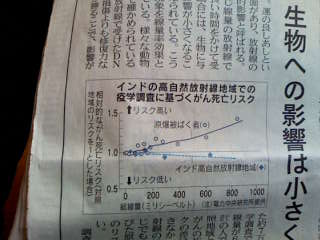
So, we know that exposing to enormously high radiation all at once or having accumulated over 100 millisieverts will increase the cancer risk. But what would happen if we were exposed to low radiation for a long period?


Nikkei newspaper of April 17 showed the above graph. The title is “The risk of cancer death based on an epidemiological research in the high radiation area in India.”  I googled some erroneous spelling, but luckily, I found the following.
http://www.ncbi.nlm.nih.gov/pubmed/19066487

On the graph, the left vertical line shows risk, and in this case, the risk is set to 1. The bottom horizontal line shows the value in millisieverts. The longer they are exposed with low level of radiation, the risk is going down. Isn’t that interesting? I heard some part of Brazil and Iran has high background radiation, so I guess the situation must be similar. In the above web article, I found the words, terrestrial gamma radiation. Terrestrial sounds mysterious. It reminds of Ashok’s blog on Paspermia and Pansmeria. What we have under our lands are scary like faults, plates, and radioactive mineral but also fascinating.

According to Nikkei, in Karunagappally, Kerala, India, radioactive minerals are scattered in the area, and the average radiation there is 5 to 10 times more than the world average. The residents are exposed to the natural radiation of 10 to 20 millisieverts a year. In 2009, a study on 70,000 residents was conducted. The result was even the people who had accumulated over 600 millisieverts showed no evidence  in the difference on risk when compared with a control group. For the same amount of radiation, if our exposure took a long period, then the effect on living thing would be smaller.

In recent weeks, I’ve gained quite many readers from Ukraine. I’m glad to see my blog statistic map turn green there. Now I know exactly where Ukraine is in the world map. I just want to say that I hear often Japanese scientists refer to what they’ve learned from the Chernobyl accident. Because the experts were able to accomplish many studies in Ukraine, the Japanese government quickly notified us about radiation when rained and the danger of pipe water for babies. They distributed bottled water to affected families. I appreciate the knowledge.


Sunday, April 17, 2011

Calculating Risk

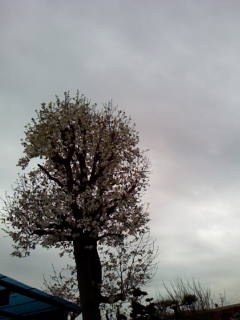
An Old and Prized Cherry Tree Behind Gumyoji Kannon


Below is an excerpt from May issue of Bungeishinju magazine. The title of this interview-styled article is “The Truth Is It Takes A Year,” and the subtitle is “Erroneous Reports on Radiation.”


Interviewer: Koichi Okamoto, specialized in Crisis Psychology, Professor at Toyo-Eiwa Women College, a specialist member of Nuclear Energy Safety Committee and Nuclear Energy Committee

Interviewee: Masayori Ishikawa, Professor of the Graduate School of Hokkaido University
Studied and worked at Kyoto University Nuclear Reactors Research Center, Tokyo University Nuclear Power Research General Center, Hokkaido Hospital,


The Petals of the Cherry Blossoms 


On page 209, this is what the interviewee said.


“To evaluate the amount of radiation, we have to add how much exposure we collected throughout our lifetime, not just in days.”


A friend of mine has recently told me that after the Hiroshima bomb, the radiation fall out onto the Kanto region--Tokyo and Yokohama included, was 10,000 times more than the previous norm. I didn’t know that. My parent died without knowing it.


“This is based on the current statistics. If our accumulated amount passed 100 mili sieverts, and if we added more, per 1000 mili sievert (1 siervert), the cancer rate would possibly go up 5 %. Therefore, if a person were exposed to 100 mili sieverts so far in her or his life, and also the probability of that person to afflict with a cancer were 50 %, then the rate becomes 50.5 %.

Today, one person out of two gets cancer, and one out of three dies by cancer. Being aware of these facts and the accumulated amount of our own radiation exposure and risks, we can choose the way we live.”


So far, I know the Japanese average is 1.45 mili sierverts a year. The Hiroshima and Nagasaki bombs happened before I was born. My mother and aunt must have exposed to the 10,000-times-over-the-norm radiation, and the descendants like us are I’m sure affected. I moved to the U.S. in 1970. So, I want to know the U.S. average by state, city, and town. My mother died of liver cancer at age 76, but my aunt moved to the U.S. around 1955, and she is 87 and has dementia, but as far as I know, she doesn’t have cancer.

I hope this helps.

Friday, April 15, 2011

Pine Trees


Conflicts continue here. Please see this amazing photo below. It is the only pine tree remained at Takadamatsubara, a picturesque spot in Rikuzentakata City in Iwate prefecture. A few days ago, I read that about 70,000 pine trees used to grow there.
http://www.yomiuri.co.jp/zoom/20110324-OYT9I00904.htm

Another beautiful spot for pine trees is Matsushima. At the seaside there, we can see many small islands covered with pine trees. It’s in Matsushima town in Miyagi prefecture.
http://www.town.matsushima.miyagi.jp/

In early 90s, I met a Japanese friend of mine at Los Angeles airport and travelled together on Korean Air to Japan. She was on the way to her home, Sendai city in Miyagi prefecture. I was on the way back to Yokohama. I told her I had never been to the northeastern Japan. She invited me to her birth home. Her house was at the foot of the former Aoba Castle. I couldn’t resist such offer, so I joined her and her family a few days later to a hot spring in Zaoh, a ski resort, and then she and I took a short trip to Matsushima next day. We had fresh oysters for lunch and watched many small islands covered with dark green pine-trees in a distance. The scenery was just like in fairy tales, photos and old paintings I had read and seen.

I haven’t seen the friend for a long time, but because of the disaster, I sent an email to our mutual friend and asked about her and her family. I received her email and confirmed that they were all well, but her college classmates lost their homes in the tsunami. I was glad and sorry about the news.

I wondered what happened to the picturesque Matsushima town. Its view is very important cultural property. It shows up often in old and current literature. Yesterday, I learned that those islands are still there, and maybe some are damaged, but they still have pine trees in Matsushima town. But 500 out of 1000 evacuees need new homes, and they cannot build where they used to live. They have to find their home in higher ground where many pine trees are standing. With prefabricated housing in mind, the reporter asked an authority which was more important, pine trees or people.

The authority replied, people. That makes sense. Now, do you think the authority will decide and cut those trees to build prefabricated houses for those 500 people? Stay tune. When I hear further news on this issue, I’ll let you know.

Tuesday, April 12, 2011

Faults and Plates


I’m not an expert of earthquakes, but ZACL has mentioned fault, so I decided to write this blog. First, I live in Yokohama, but about six months a year, I live in San Dimas, California which is close to famous San Andreas Fault. I don’t know how close it is though. According to my digital Britannica, the total movement along the fault during the last few million years appears to have been several miles. There are many faults all over Southern California, so we cannot avoid all.


About Plates, please see the attached photo and find two red arrows toward the bottom.
The left arrow is the Philippine Plate. The right arrow is the Pacific Plate. On March 11th, the Pacific Plate pushed the Land (Japan) Plate and caused the 9.0 earthquake. “X” was the epicenter.

On the photo, above left shows a cross section of the plates, and downward movement of the Pacific Plate (see red arrows), pushing the Land Plate upward. The red dot shows the point the earthquake occurred.

Yearly, according to Asahi, in the western Japan, the Philippine Plate moves 4 to 5 cm, and in the eastern Japan, the Pacific Plate moves 8 to 9 cm toward the bottom of the Land Plate. So, all these movements have been piling up over the years, and sometimes, this stress causes earthquakes.

After 9.0 erupted on March 11th, so far, five aftershocks of above 7.0 already occurred. Experts have said this trend will continue in a diminishing way for six months to a year, but it is still possible to have 8.0. Last few days, I felt three pretty big jolts. In Yokohama, they were 3 and 4, but in the northeast, they were 7.1 and probably 6 and high 5. It’s so many, it’s hard to keep track.

This morning, I was walking toward a commercial building and saw a worker filling a crack with cement next to a wet concrete corner of the foundation. I chatted with him for a while. The building had three or four cracked glass panels after the earthquake, but they were already fixed.

It must have cost the owner a lot of money to fix all that. Concrete buildings withstood the tsunami, but for smaller earthquakes like magnitude five or so, concrete buildings probably cost a lot of money to fix cracks. So far, I see wooden houses and apartments have survived with almost no problem for magnitude 5 or 4.

Monday, April 11, 2011

Evacuees

from Asahi Newspaper on April 11, 2011


My very good friend in Yokohama came from Saitama prefecture. Michiko was born there. After she married, she’s been living in Yokohama. But her brother still lives in Saitama and takes care of his pear orchards and rice fields. She said, a while after she married, one day she heard from her brother that a new high school had sprung up near their birthplace. The name was Kisai. That’s an unusual name. Ki means horse riders and sai means west. During 70s and 80s, new schools were created all over Japan. Then many years went by, the bubble economy burst, and the population dwindled, and she heard Kisai High School closed down. So, that was the last time she heard about the school.


But once again, she heard the name during the tsunami news two or three weeks ago. 1200 people of Futaba town in Fukushima prefecture were evacuating to former Kisai High School. Michiko said her birthplace is among rice fields, and nothing much is there. I’m fascinated with country scenes. She said she never wanted to go back to live there. I kept asking her why. She added, “But, the town has water and everything. A train passes through the town.”


According to Asahi newspaper of April 11, the chart shows the numbers of evacuees in each prefecture. The total number of evacuees from 9.1 earthquake and tsunami are 163,781. The rightmost top tile is Hokkaido, and it accepted 702 people. Going downward, Iwate is 48,736, Miyagi, 54,764, Fukushima, 25,669, Tochigi, 1669, Ibaragi, 879, Chiba, 863. The second rightmost tiles, from top to bottom, Aomori,975, Akita, 1881, Yamagata, 1913, Gunma, 2861, Saitama, 3514, Tokyo, 1367, Kanagawa, 945, and so on. Saga and Yamagata prefectures had offered to accept 30,000 people, but ended up with fewer people.


Saturday, April 9, 2011

Doubts and Damages


The article, “Question Tomodachi’s True Value” appeared on page 3 of the April 7th Asahi newspaper. According to the paper, the Japanese government officials are extremely dissatisfied with the way the U.S. handled in the face of the disaster. Tomodachi means friends, and the name of a new U.S. army operation for the earthquake. I expected such article eventually, but I was surprised to see it already.


The body of the article is as follows including my interpretation:

The U.S. changed her stance from waiting for Japan to come forward for help to pushing her way in. The U.S. was getting frustrated with the Japanese government and being doubtful because Japan was not accepting the U.S. offer of support.

The above issue happened in Kobe earthquake, so the old issue was a matter of time to come up. In fact, I was discussing about it with a Red Roomer through email at the beginning of the event.

The article said the U.S. went on her way without consulting with Japan.

My interpretation of the next paragraph: If the U.S. were truly a friend of Japan, President Obama would have consulted with PM Kan before going out blasting his heroic 80 km zone requirement and providing chartered jets for 9000 Americans to go home.

Japanese officials’ complaints were,

“The U.S. should have consulted with Japan beforehand.”

“They probably think Japan as an underdeveloped nation.”

There was also tension between the two countries about America’s offer of robot to work in the radioactive environment in the nuclear plant.

I don’t know what happened, but the robot idea sounds super great. Why-don’t-you-accept-it probably came first rather than thinking of other’s situation.

Then, the U.S. pressed Japan asking if Japan had a strategy, and whether Japan had preparation for crisis.

This is my opinion. I think those questions are out of place and occasion. It was during the national crisis. Asking such questions to the head of Japan does not show good spirit of support. That is not a manifestation of good global teamwork. If the nuclear power plant 60 km away from Manhattan was hit by 9.0 earthquake and tsunami and lost all the powers including emergency diesel power, what does President Obama would do? I wonder how he feels if PM Kan asks, “Do you have a strategy? Are you prepared for this?”

Some Japanese official made comment on this issue. “This is because we have differences in making decisions. The American way is top-down approach, but Japanese way is bottom up.” He insinuated the difference in culture.

Yes, I agree that there are differences in cultures and languages. But, this is more about President Obama’s personality than the American way, and also I believe President Obama was not well informed. I had worked with such a personality once facing a systems disaster. That engineer was frustrated because I moved in a snail pace. When I looked back on that crisis, he did what he did because he didn’t have all the information. And at the time, I had no capacity to explain well while thinking of a solution.

The negative consequences of President Obama’s sweeping actions shot and spread more fear to the international communities and also Japanese citizens. Damages have already made. Farmers had thrown away their vegetables even though their products passed the requirement. Fear and tainted reputation climbed overnight supported by inadequate, erroneous, and sensational foreign news.

30 or so foreign consulates including Nepal moved their offices out of Tokyo. It is interesting to note that Japanese announcers keep including Nepal in this picture because Nepal is the only Asian country joined in this move.

In the meantime, the government is expanding radiation monitoring spots and finding some of the spots still emit similar high level while other places, lower. The day before yesterday, 7.1 aftershock hit off the coast of Miyagi, and Tepco’s other nuclear plant, Onagawa lost some power…


I wanted to change my mood. I didn’t need to, but I went to have my hair cut yesterday. I always look forward to see my hairstylist and chat. The last time I saw her was right before the earthquake. We said hello and chatted how horrible the earthquake was, then I said,

“How’s your son?” Her son is very active seven-year old. I met him once.

“Oh, he hasn’t been with me,” the hairstylist said through her mask. She is my daughter’s age and married to an American. She is beautiful and has very warm personality. She is from the northeast.

“Oh, what happened to him?”

“He is in the U.S. with my husband because of radiation.”

“Oh, I see. But the radiation in Yokohama is low. Do you know it’s lower than the U.S.?”

“No. Really?”

“It”s 0.04, and the average natural radiation in the U.S. is 0.4. It’s on newspapers daily. And the faucet water in Yokohama has been at the safe level even when we had rain.”

It’s apparent that they haven’t been reading Japanese newspapers. Or maybe, her husband wanted to take advantage of the charter jet to visit his family in the U.S. If the husband thought the situation truly dire, he would have taken his wife with him. About her mask, she and some others wear because of pollen allergy. Right now is the worst time of year. I wear sometimes to keep me warm from very cold winds.

This morning, it started to rain. I filled my plastic containers with water just in case.
Then I read Asahi morning news. On page 5, it reported that President Obama’s call for the 80 km radius evacuation was based on a fictitious scenario, not scientific data. It said that Randy Sullivan of NRC explained, ‘It’s better than not making a decision.”


Thursday, April 7, 2011

Amenimomakezu by Miyazawa Kenji

kobus magnolia


Miyazawa Kenji was a fine educator who lived after his ideal life in the northeast and wrote poems. Amenimomakezu is the title of the poem below. The literal translation of it is “Not to be defeated by also rain.” Ame (rain) nimo (also) makezu (not defeated). This poem is one of the most popular modern Japanese poems.
http://en.wikipedia.org/wiki/Kenji_Miyazawa


“never let rain bother” by Miyazawa Kenji


translated by keiko amano


never let rain bother

never let winds bother

never let snow or the heat of summer bother her

built with a strong body

with no greed

never hold grudges

always smiles in a quiet way

eats two bowls of brown rice a day with a bit of miso paste and some vegetables

acts on various matters without considering herself

looks, listens, and understands well

plus not forgetting

under the shade of a pine tree out in a field

she lives in a tiny thatched-roof hut

in the east, if a child fell ill, she goes out there to care for the child

in the west, if a mother grew exhausted, she goes and carries the mother’s load instead

in the south, if a man dropped near death, she goes and tells him, “Don’t be afraid”

in the north, if someone started a fight or tried to file a lawsuit, she says,

“That’s stink. Stop it”

on a drought summer, she let her tear well up

on a cold summer, she plods about

everyone calls her Blockhead

no compliment

no complaint

that’s the kind of person

I want to be

Wednesday, April 6, 2011

High or Low


natural radiation map  April 3rd


Thank goodness the leakage of high radiation water at last stopped. On high or low, I’ve learned that radiation rates depend on variables, but that leak from the pit near the Reactor two was way too high.


At Fukushima Daiichi, operators have been dumping their accumulated low radiation water into the ocean since yesterday. They call it low because apparently France and Britain have been dumping their processed radiation water of similar rate. I didn’t know that. Nobody has given us the comparison data. I read it in Nikkei newspaper yesterday. It was not on the first page. I’d like to know the rate from each country such as Japan and the U.S. We all must be dumping the processed water tainted with radiation.

By reading the New York Times, I haven’t seen much explanation about high or low on radiation. Their articles tend to report on high, higher, and highest on radiation in Fukushima. An article on the NY Times on April 1st still stresses on expanding the danger zone to 80 km radius. The article focuses on one higher radiation spot. I wondered if the article was a reprint for a moment.

Daily, Japanese newspapers report on radiation rates by region. They are low. See the photos. Again, Japanese announcers do not compare much with foreign countries. They would say, “It has gone up slightly,” or “it went down to normal rate.” The rates of natural radiation in Japan are very small compared with the rates in foreign countries. I watched one Japanese program in which a Japanese expert showed the average radiation of the world as 0.5. I think the unit is micro sievert. That’s ten times higher than the Japan’s average. I couldn’t believe it. In another television program, I saw the average of the U.S. natural radiation was 0.4. In Yokohama, it’s about 0.04. 0.04 is the Japan’s average.

Right now, Tokyo’s average is double the Yokohama rate, but no need to be alarmed when we compare it with the world average. That’s why people say, “it’s high or higher than normal, but it won’t affect on our health, it’s minimal.” According to the numbers on the photo, that’s true. Government officials and announcers are telling own citizens, not to the citizens of other country.

About the food contaminated with radiation, one Japanese expert said that if we ate, although we will never do that on purpose, such spinach and drink such water and milk for one year, the amount of radiation we take in will be similar amount as we might receive if we simply live in a foreign country with the average radiation. You can imagine why they say that. But I assure you that the opinion was directed to calm the Japanese public. The expert did not speak in an arrogant way, and no one would like to compare with foreign countries and say we are better in any way, especially at the time of spilling HIGH radiation water into the ocean.

I can see why Japanese government officials don’t talk much comparing with foreign countries although they are doing it now in a very slow and delicate way. They don’t want to create more harm than they already have. They don’t want to boast the good thing Japan has enjoyed all these years in face of this gigantic nuclear radiation problem.

I don’t know the reason why the natural radiation Japan receives is so low compared to the average in the world. I guess it is just the way it is. It is interesting though that China is very close to Japan, but their average is 0.54.

Further, even in Japan, our natural radiation rates vary by region. I heard that Kansai area is double the Kanto area. Osaka and Kyoto are in Kansai. Tokyo and Yokohama are in Kanto. Separately, also Ibaragi is in Kanto, not the northeast. One of the reports I read in Huffington, Ibaragi was the part of the northeast.

But how the radioactive materials are spreading if they are? I don’t understand their spread with the relationship to the natural radiation map with numbers. Asahi newspaper listed the following site but it said it isn’t detail. It also said the machine broke after giving an output once. www.jma.go.jp/jma/kokusai/kokusai_eer.html IAEA also is collecting data for making global forecasts. I wonder if the system was used before and how accurate it has been. I see many sites, but I just need one easy map to see and the info. to be correct. That is my concern.

About the design of Fukushima Daiichi Nuclear reactors, it was confirmed that it was old. No surprise there. Toshiba and Hitachi tried to imitate GE’s design to learn how to build reactors. The emergency generators that failed should have been housed in more secure place. The CEO of GE made his visit to Japan after three weeks from the accident. I haven’t heard much about whose responsibility the design is, but I sense a little bit what’s going on. The language barrier must be great. That’s my hunch. I think imitating is a good way to learn as junior engineers, but to build nuclear reactors, imitating alone is enough. We have to know what we are doing from core and include all the error routines and seek expert opinions in each category and synchronize all the knowledge. I saw a photo of spaghetti wiring plus tube looking things overhead that a former nuclear reactor engineer has shown. I used to watch customer engineers work under the floor of mainframe computers, but it is much worse. It looked like a giant mess.

Friday, April 1, 2011

Neighbors


I hope the spill into the ocean stop immediately. I feel sick thinking how it is making people all over the world feel. It is also so sad that the effort Japanese have been putting into recycling, caring for their health, and living longer could be nullify by this single event. I hope people in the northeast can soon settle down in reasonably comfortable places and be able to open their large windows without worry.


It’s been 20 days since 3/11. Some communities near the nuclear plant have moved away together from multiple nearby shelters to another shelter outside their prefecture. They plan to stay together as a community even though they cannot go back. Togetherness is preferable, Japanese experts say. If your town were devastated right now, would you move together with your neighbors?

When I started to write this earthquake series, Julia had asked me to write about my neighborhood. The photo is one of my neighbor and me in front of a shed in my garden. He still lives in the same house where he was born with his mother. Last year while we were talking over the fence, I told him I like his house. In response, he twisted his nose. To me, he is one of the lucky people, but unfortunately, most Japanese have not shared the same sentiment as I have. Most Japanese have rebuilt their houses, and their original authentic wooden houses with verandahs and large windows are almost all gone from Yokohama. Our old houses are rare nowadays. I love old Japanese houses.

So, the houses around my neighborhood have changed over the years, but my neighbors have remained the same. They are my childhood friends. Some married, some didn’t, and some live with their siblings or parents. But we no longer make visits to each other unless we have a common problem. The end of last year, we had one such occasion. Our land owner changed. It could lead to problems. So, I made calls all over, and we got together and shared information. That was a good thing.

Otherwise, our neighbors and I only greet if we happen to meet. I chat a little with a few when I see them while shopping or passing by. So, I thought about what we would do if a disaster struck our community. I don’t think we would gather like the northeast people and want to establish the same community. I think the northeast is much more together than the people in Yokohama. Our team spirit may have deteriorated.

But being tightly together has demerit. Asahi newspaper on March 27 reported on the first page about the issue. Under a subtitle “Cannot abandon and leave,” I’ll translate the body. A bus is scheduled to leave from Ootuki High School in Ootuki town. Oguni Kanako, a barber in the town, entered the bus with her children. She said,

“I want to remain in the town. I don’t want to go. But I have no house, job, or schools.”

The man in charge of a 300-member shelter in Kamaishi said, “I can’t go leaving my colleagues and friends and go to an inn.” He said one member was leaving from his shelter to get to an inn. The member said to him or her before leaving,

“When I come back to clean my house, please let me stay at the shelter again.”

“Abandoning us and wanting to come back as she pleases, I don’t get it,” the man in charge said.

There were only few who went away from the shelter. This must be tough for those people. Being a member of a tightly knitted community has merit and demerit. The kind of patience my American born daughter would probably never possess would be exactly the cause of their strong teamwork. Readers probably understand it, so I say no more.

Tuesday, March 29, 2011

The Biggest Room

The biggest room anywhere is the room for improvement. With this note, I feel privileged to list the following four items.


1. Tokyo Shinbun reported yesterday the differences in two tsunami counter measures. Tepco operates Fukushima Daiichi Nuclear Power Plant, and Tohoku Denryoku, Onagawa Nuclear Power Plant. The Onagawa plant is located in Miyagi prefecture and it was closer to the epicenter of the 9.0 than Fukushima Daiichi plant, but it had a little damage, and all the reactors have been stable.

For the Onagawa plant, Tohoku Denryoku estimated the worst tsunami at 9.1 meters high and built the plant on 15 meters higher ground which was 5 meters higher than the place Fukushima Daiichi Plant is. Tepco estimated tsunami at 5.5 meters.

I did hear on March 12th or 13th from a Tepco spokesman about their assumption, 5.5 meters tsunami. I had no idea how high a tsunami climbs, so I felt sympathy to Tepco then. Since March 11th, I’ve listening to new numbers for the highest tsunami. It’s been climbing up. I heard “more than 10 meters” one day, “must be 14 meters or so,” then yesterday, “It was in fact 16 meters,” and according to Nikkei newspaper yesterday, Yoshiaki Kawata, a professor of Kansai University said the number, “50 meters.” He is a Disaster Prevention Engineering expert. All the information came from reliable sources.

I think all their numbers are matters of national security. All the companies that own nuclear power plants need to share such important information among them. On sharing, I don’t mean to expect such as “Oh, I sent my report and mailed it,” or “I don’t know what they did with it because they haven’t responded.” To me, this is not the way to sharing our concern. To be responsible, sometimes, we need to be pushy! For Americans, we use the word, persuasion, but for Japanese, I would use this wrong word, push push and push. We need to persuade others to check and balance.

Also, according to the article, Fukushima Daiichi plant was built facing the vast Pacific Ocean, but the Onagawa plant was built inside a bay. So the tsunami weakened a little by the time it reached the plant.

It sounds as though the design of the plant has flaws. NY Times on March 25th shows that the plant was built in 1970. My goodness, it’s very old for such a super technology.. I guess Tepco does not own reactors, but paying license fees yearly or something. I don’t know the detail, but IBM mainframe machines are similar. We renew contracts for license, but IBM provides new machines, and computers don’t explode. So, this comparison is not the greatest, but l’d like to know the detail about the contract on maintenance. I think GE has responsibility in the design of the nuclear plant and the maintenance is a part of the design, I think. What do you think?


2. I tried to find the article I’ve read, but couldn’t find it, but I read that the regulators or engineers had recommended Tepco to retrofit the reactors before the earthquake happened. Tepco has not responded, but the regulator gave renewal permission anyway. Readers probably read that news because I think I read it in English. It must be more than a few days old papers. Yes, I’m disturbed by this article, but I’m equally disturbed to have read it in English before finding the counterpart article in Japanese. Maybe, I missed it because I’m not reading all the papers. Now I try to read Nikkei, Asahi, and Tokyo newspapers, and sometimes, Yomiuri.


3. Scheduled DR exercise is a must.

Companies need to follow yearly or whatever reasonable timeframe schedule for disaster recovery exercise.

In 2008, the northeast general Inspection body conducted a disaster recovery exercise, Tokyo Shinbun reported yesterday. The assumption was to be hit by magnitude 8.0 off the Miyagi coast. It included two prefectures which house 22 towns in their cities. Private companies joined them. The article said, “The exercise excluded Fukushima prefecture. Because the headquarters of Tepco is located in Tokyo, therefore scheduling coordination for the DR exercise would be difficult. Tepco did not join the exercise. It operates two nuclear power plants in Fukushima. There is more to the article, but I stop translating it for now.

I can’t tell you how important scheduled disaster recovery exercises are. I used to be a disaster recovery contractor in systems. My background is operating systems programming in mainframe computers. I did data center merge, split, moves, and set up a disaster recovery exercise environment and scenario. I did that from 1984 to 2008. Although I don’t know anything about nuclear reactor, I’ve learned quite a bit in last two weeks. What I’ve learned is that the basic idea is the same. We can’t act properly at the time of crisis without exercises. So, I recommend Tepco and all other companies to conduct scheduled DR exercises.


4. Need to talk.

PM Kan has been criticized to have visited Fukushima Daiichi at the time of crisis. Boy, I can’t believe this criticism. This proves to me that Tepco executives and many people in Japan are not in tune with crisis management. I knew all along that we are behind in setting up DR exercise and crisis management, but I thought by now, we must be equipped with such procedures. I was wrong. If a manager or two cannot receive PM at the problem site and communicate what’s going on at the time of national crisis, we all are in trouble. Communication is required especially in crisis. I think we need to get used to that if we aren’t.


Also, I want to add one more odd matter. I didn’t see any women among Tepco executives or in other scenes. I think they can benefit from female talents. I think at least she would have noticed the workers who were going into the Turbine room without rubber boots!

Saturday, March 26, 2011

Conflicts


1.  A while back, Edano, chief cabinet secretary, ordered the people in the radius between 20-30 kilometers to remain indoors. But criticisms arose, of course, because not all the survivors there could receive relief supplies. Not everyone live in the shelters. Some still live in their homes. They have to get to a shelter daily to receive supplies.


2.  Since the 9.0 hit on March 11th, some airlines haven’t landed in Narita airport. The U.S. pledged a return flight to 9000 Americans. On 24th, according to Nikkei newspaper, French ambassador said during his interview that he did not order his citizens to evacuate, but some of them and companies left Tokyo and the surrounding areas right after the earthquake hit. He said such behavior was inappropriate, and he wanted to apologize to Japanese people.

Edano has said he understood such actions. He said he would do the same if he were in similar situation. I feel the same, and I mean it, too. But, when I read the above apology by French ambassador, I appreciated it.


3.  If we received little information from Tepco (Tokyo Electric company) or the government, it might create fear in us. So, newspapers reporters and television announcers have been repeatedly reciting the rate of radiation for various items so that correct information would calm us down. If I see such news once and be assured of safety, I think it’s good. But if I see a high rate again and again, it isn’t. The thing is, if we worry, we tend to watch more. But again, I appreciate correct information.

According to Asahi newspaper on 25th, after Chernobyl nuclear blast, only thyroid cancer rate went up, but no other illness has increased. It said that the increase in thyroid cancer at Chernobyl came from those babies who drank contaminated milk over a period after the explosion. If that were true, why hasn’t the authority explained to us this important fact earlier? Does everyone know this except me?

Also, I’ve learned that, according to Nikkei newspaper on March 26, the voluntary restraint set for radiation by Japan’s government is 5 milisierbert. But it is planning to raise the amount to 10 milisierbet according to International Control of Radioactive Protection. ICRP raised the value to 10 milisierbert in 1992, and at that time, they decided that they would increase further if alternative products were unavailable. Hmm. I didn’t know that is how it works. Again, why hasn’t the authority explained this important fact in detail before? I did hear before that Japan has stringent regulations, but I wish I was confirmed on this fact backed with numbers.


4. Page 2 of March 24th Ashahi newspaper: A 64 year old man who lives within 40 km radius to the nuclear plant spoke angrily, “The government said my area is safe, but the city workers said as if it were very dangerous. Which is it? The rumor spread. People think the entire city could be in danger. Nobody will deliver goods to the town where people are leaving.”


That’s all today.

Thursday, March 24, 2011

Legitimate Scare Part 2

A Japanese physicist and excellent writer, Terada Torahiko wrote,

“It’s easy to be overly scared or not scared at all, but it’s difficult to be scared legitimately.

It is so true. With that note, I have translated the following article from Asahi newspaper of March 23, 2011. This is not full, but a partial translation, but I think I captured the main body of the article. The following article appeared on page 5.

Yoichi Kato, a member of the editorial team flew on an American rescue team’s helicopter to a disaster stricken area on 22nd and 23rd. On the first flight, there were dozens boxes of water plastic bottles, dozens of plastic bags full of used clothes, and three workers dressed in a dark special uniform sat among those used clothes as though they were half buried in them.

The first stop they made was the Shizugawa Middle School. Members of the Japanese defense force and local people came over. The American team members on the helicopter did not speak Japanese. On behalf of the team, Kato asked the people there,

“What do you need the most?”

“Nothing particular,” a local government worker said.

Kato was surprised with the reply. “

Many goods have been gathering here from all over Japan, and we haven’t been able to distribute them all,” the worker said.

But they needed water and clothing after all, so the American team downloaded their supplies. Kato flew back with the American team to the carrier (Ronald Regan), but there were no more goods available. Again, they flew the empty helicopter to search for survivors.

Before the beginning of the first flight, the team was briefed with emphasis that their mission was to search and rescue. The pilot was giving his order to the team members, “When you see a survivor in the ocean, you go,” or “If you see a survivor on the ground, you’ll go.” The members on the helicopter stared below looking for survivors or a sign of SOS.

The second flight the team took, they landed in the spacious field among a housing complex of the same town as the first flight. A local person said the minimum needed goods have been supplied at a middle school nearby, but they needed gasoline. They said they have been pushing a cart on foot for a 6-km roundtrip daily in order to transport their needed supply. They said they needed insulin for diabetes, clothes detergent, cotton work gloves, candles, and shampoo. An American team member wrote it down, and told the locals, “I’ll bring them over tomorrow or the day after tomorrow.”

The Japanese rescue member in charge on the Ronald Regan carrier said, “The rescue effort has entered a new phase. We are now required to provide more detailed and considerate efforts according to the survivors’ needs.”

For the issue of radiation contamination, the Americans were surprisingly extremely cautious. When the reporter got on the helicopter originally at the Atugi airport (Kanagawa, the same prefecture as Yokohama where I reside), he was asked to wear a white protective uniform and a pair of rubber boots. He was also asked to keep wearing a radiation scale. Then, a worker raised his radiation measuring device and checked the reporter’s body all over from top of his head to the bottom of the boots. Afterward, he took off the uniform and the boots, and he was permitted to enter the carrier.

When the reporter asked the location of the carrier, the answer was,

“231.5 km away from the Fukushima Nuclear Power Plant, and 37 km to 55.6 km from the coast.” The reporter inquired further and was told that the American Navy was ordered not to go closer than 231 km from the Fukushima No.1 Power Plant. Even within the radius of 93 km from the site, airplanes are not allowed to fly over.

The reporter was also asked to sign a paper titled “Prevention of Potassium Iodine” and also asked to take an iodine tablet. The town they had visited was Minamisanriku town in Miyagi which was within 185 km radius. When they returned to the aircraft carrier, the result of the radiation measurement gave a no-problem result.

When the helicopter flew initially from Atugi airport (it is in the same prefecture as Yokohama) and landed on the carrier, not only the crew and reporter, but also the body of the helicopter and all the goods were checked for radiation one by one. A member of the crew there said that he has been inside the carrier almost the whole time as though he were in the submarine. But another member said, “This is nothing compared to the training for Nuclear wars.”

Legitimate Scare Part 1

Since four days ago, milk, yorgurt and pancakes have been unavailable at the restaurant I go to in Yokohama because the milk from Fukushima was stopped circulating. After a week or so, we had rain, and the rain collected all the radioactive material in the air and caused the tap water in Tokyo to raise its Becquerel value. The level became 131 becquerel which was double the standard amount acceptable for infants to drink. For adults, it is 300, so for most of us, it is safe. But since then, it went down to 79. Problems will go up and down unless the problem at the plant is dissolved to a reasonably satisfactory conclusion. Until then, steams from the plant will come up because fire fighters are struggling with the pressure and the temperature. When the temperature goes down by watering, the pressure goes up, then steam comes up, workers retreat, then the steam stops, workers return and work for connecting electricity so that cooling systems will be enabled, meantime the temperature goes up again, so fighters again pour water into a reactor and so on until all the reactors are back to normal.


On the water scare since yesterday, the government will provide three bottles of drinking water to each baby under one year old. According to the standard, there is no harm to adults even if people continue to drink. Most of radiation will dissipate in eight days. I’m glued to the development...


Also, television programs have been showing volunteer rescue efforts, and here and there, announcers and other people appeared on the screen and said repeatedly, “Don’t send used clothes. It takes too much time and effort to sort them out. We send survivors only boxes of new clothes which are divided clearly in sizes.” A survivor in her interview, her shelter received used clothes, but they threw them away because some of them had stain. There must be hard effort to match the needs of the survivors and their needs changes in each day. Any help is appreciated, but it will be wasteful if the needs do not match. The kind of help that matches the needs of survivors is much more appreciated and least wasteful.


My daughter’s boyfriend sent me a heartfelt message to me from San Francisco asking me to come back to the U.S. He wrote he could not sleep. I appreciate his concern. I wrote him that my daughter is a lucky woman. I wish I have a boyfriend like him.


I wish everyone can read and listen to the Japanese news. My daughter studied some Japanese, but not long enough. With this blog, I hope to help her and her boyfriend and everyone else. They can research and compare the facts and standards, kilo meters and miles, and other details by accessing both Japan’s and American news. If you have questions, please let me know. This post will continue to next blog.

Tuesday, March 22, 2011

My Thoughts on US Reports

Today is Tuesday. We haven’t had power outage since Saturday. Thank goodness.


So far, the Japanese news I’ve been reading are quite detailed, not as vague as some U.S. news reported. But it takes time reading because I have to think and reread. I’ve learned quite a lot on nuclea power plants and radiation so far. I only read a few American reports on the web, and compared to the Japanese reports. Those few reports looked sensational and pessimistic. Also, I see here and there wrong information. For instance, Ibaragi is not the northeast. Ibaragi is a part of Kanto plain. That was on the Huffington Post. You might say it’s a big deal, but I don’t feel like reading news with fundamentally wrong information. I also see a mix-up or unclear terminology, or vague or confusing names describing the inside parts of reactors. Japanese newspapers show very clear view of the reactor’s entire picture. I was confused with those terms looking at the picture in U.S. reports. They make a big difference.


We had an earthquake in Kumamoto, Japan, yesterday. Today, I felt about magnitude 5 three times although in my area, it was diminished to be 3. As I write this, all the lamps are swaying. I just wish at the end of all these shaking for a whole month, a new island like Okinawa will appear off Yokohama. I think we deserve it.


So, I decided to go to the Yokohama central library and read American news papers. There, I found the NY Times and the Washington Post of March 16th and 17th. The library used to carry the Los Angeles Times, but disappeared a year or two ago because of their increasing budget cuts. I had protested it, but I’m not a VIP. I’m just a blogger. Below are my comments to some of the articles I have read.


NY Times March 17, 2011

Page 1. “More Dire Appraisal of Crisis Creates Split With Japan”

About Jaczko’s most startling assertion that there was now little or no water in the pool storing spent nuclear fuel at the No. 4 reactor…


With my sympathy, I wrote this comment. I don’t know Jaczko’s exact conversation with a Tepco official, but I thought about a discrepancy in language. If I’m speaking with my Japanese colleagues or boss for the similar subject, I could say about the water in the pool, “kara ninatteiru” or “naku natteiru.” Kara means empty, and “nai” means gone. Those phrases can be translated as “it became empty” or “it is gone.” Because I’m Japanese, speaking to Japanese persons in a similar situation even if the Japanese person is speaking in English, I will comprehend what the person said to me with a bigger margin. Of course, I wish the person would communicate more detail without my further inquiries, but in Japanese communication, both of us have bigger margin in understanding. But, not just in Japanese, but in any communication, we always have to be smarter than others if we want to accomplish our task. Don’t you agree? So, if the target person seems not giving an information we require, we need to ask more creative questions while being aware that no one can see inside the pool with our naked eyes.


Article: “In Tokyo, a Dearth of Candor…”

In a press conference, Mr. Edano said that a steam is rising from No.3 reactor, so radiation is spiked, and all staff members moved to a safe place.

I don’t think he said “temporarily,” but I understood what he said. It wasn’t vague. It was clear. On this issue, NY times reported that what he said confused foreign reporters, and Al Jazeera made panicky headlines. I’m amazed with this report. How in a world, those reporters assumed the workers abandoned this gravely important job. I wish a foreign reporter with such negative assumption should have immediately asked him, “I don’t mean to insult your country’s integrity, but have you just said your staff members just abandoned their work?” Reporters are brave animals. I hope they ask such questions.


The Washinton Post March 17th, 2011

Article: U.S. government offers to evacuate Americans from 3 cities in Japan


I find the ending paragraph a bit disturbing. It said, “Yukio Edano, the government’s top spokesman said Thursday that it was understandable the U.S. government might take a “more conservative approach in protecting the lives of its nationals,” because the U.S. is not directly charge of bringing the nuclea plant under control.” I was listening to this press conference, and I didn’t hear the following, “because the U.S. is not directly charge of bringing the nuclea plant under control.” He didn’t say that. Edano said it is understandable, and he would do the same if he were in the President’s situation. He spoke with much consideration to President Obama. He repeated this. Do you feel what I do?

Sunday, March 20, 2011

Fire Fighters

Spring starts tomorrow.


People are frustrated because they’ve been unable to help while the survivors need help desperately. This is the first time I see many men even in leadership roles are crying in front of cameras. I saw on television that a fire fighter went to close a gate to fight tsunami after the 9.0 hit. He said his mind was completely occupied with his work. After the tsunami subsided, he went back to his house walking through debris. He could not find anyone there, he said. Later on, a rescue team found his four family members upstairs of their house, but all were dead.


To be effective in rescue efforts, each affected area needs a local leader with an organized and able team. But, those local teams lost members, and the surviving members lost their loved ones or their houses or both. Today, the leader of Ootsuki town was found dead. He was conducting his town rescue meeting when the tsunami hit. Communication and transportation stopped. Their streets are filled with large debris from tsunamis. Cars disappeared along with dwellings and businesses. Some cars survived, but gasoline has been unavailable. Even airports and harbors are damaged severely.


But the situation is improving here and there. A part of their important airport and harbor were restored, and goods have been transported to the rescue centers. But it’s been slow. Not fast enough. Some people are still living in those areas without any electricity, goods and support. In an interview, one woman said she worries about safety. We haven’t heard of much negative news like looting, but I sense that immoral people are at work. They should be caught before they touch other people’s properties and should be sentenced to the highest penalty.


One of the kind emails I’ve received, I wrote back with a comment about the past criticism Japan had received in the past which was not accepting foreign help in the Hanshin Earthquake Disaster. I told the sender that I was glad that in this current disaster, Japan seemed accepting help from foreign countries. This issue has been on my mind ever since Hanshin Earthquake disaster.


Who would resist help at the time of disaster? The sender had a legitimate concern. She wrote to me, “…I think it shows willingness to accept the love the world wants to offer and to not to be ashamed in this predicament because, after all, it’s a natural disaster. Could happen to any of us, at any time.”


I appreciated her words. But I thought it must be hard to read Japanese behaviors and news in English. There have been always language and cultural problems, and the situation has been changing every minute, and over the years, Japanese behaviors have been changing. After all, we need all the help we can get. I don’t think anyone want to resist others’ help, especially at the time of this enormous crisis. We all appreciate it. But the Japanese receivers must be going through difficulties in accepting some of the help. For instance, on 17th, 6 fire engine trucks and one American truck went to No. 3 reactor to send water jets. Asahi newspaper reported the six trucks shot 40 tons of seawater, and the American truck, 2 tons. There were 30 trucks which were gathered already from all over Japan, and they were to take turn, I’m sure. This is my imagination, not non-ficition, but I think the fire fighters were required to include an American engine. It’s a gesture of accepting. At the time of crisis, I don’t think this is easy to do for Japanese fire fighters no matter how much we are appreciative. They probably rather use their own vehicles. Also, I read in the report in Huffington news that the workers inside that American truck were Japanese.


What do I sense from those sentences from a Japanese newspaper and an American report? It’s hard to offer help and accept in some cases. It isn’t like depositing money into an account. I imagine the conversation behind those critical scenes. I feel for those Japanese fire fighters’ frustration when they were required to operate other than what they are used to. And I also feel very much for American fire fighters. I can imagine their disappointed faces. This is what I think from reading both articles, but I could be wrong.


Talking of fire fighters, about 50 fighters have been acting to save the nation. Yes, they are saving Japan, not just those local people. I’m speechless. I don’t know how to describe my emotion. I wish to express how appreciative I am about their actions.

Sunday, March 13, 2011

Following Up

Notice
Because of the earthquage, we all close
 at 14:00 today to save energy. 
Wing at Kamioooka, Yokohama
March 14, 2011 
Today is March 14th, and right now is  15:31.  But I still have problems in updating to current date.


If someone asks me which country is the most ready for tsunami, I will still reply it is Japan. If Japan wasn’t, yes, the disaster could have been in much worse situation. The whole country could be completely incapacitated by now. So, I expect we’ll be limping here and there in order to recover. I already hear the secondary disasters here and there. The exterior of the second nuclear reactor exploded today. They have six all together there. The core energy is not affected, but it is scary.


This disaster was not Magnitude 7. Not even 8.8. It was 9.0. I heard that the difference in energy between 8.8 and 9.0 is much larger that the number suggests. And the wait for the tsunami wasn’t standard one-hour, but it took only 9 minutes. At the time of crisis, one hour is short. 9 minutes was probably like a blink of eye for those survivors. The tsunami pushed toward inland with tremendous force, surging to build like a huge dark wall (one reporter mentioned 30 meters high, but I haven’t confirmed), travelling up to 5 kilometers nonstop, and then, it pulled back as forcefully as before. In Fukushima, they had a very impressive, long tsunami guarding wall. It was 10 meter high, but the tsunami went past it.

Because of more nuclear reactors’ failure, we had announcements last night about energy conservation by groups. The power company, Tokyo Denryoku, divided the area into five groups, and their schedules were announced, but gave no other detail. Many free phone numbers were announced, but when I called two numbers for my area, I heard the message, “It is crowded right now, so please call back.” The web site for the detail was listed, but I received an error on my cell phone. This morning, I heard the schedule for the group one was cancelled. It was scheduled to be out of power from 6:20 am to 10 am. Then one hour later, they announced again to say that they might resume according to their original decision. Most transportation companies seem to contribute in conserving energy by stopping their services here and there. Some train and power services could stop without prior notice. But some confusion cannot be avoided. My cell phone has been erratic, but I can see my email.

Before I returned to Japan last week, I almost bought a one-week railway pass to visit Miyagi, the northeast, now the disaster area. I wanted to travel to Aizu Wakamatu before April. In April, all new classes start, so I was thinking of a short trip to visit there. But because of high yen plus Federal Express charge, the cost of the pass became similar to one regular round trip ticket I could buy at any station. Besides, I didn’t think I could take maximum advantage from one week pass. So, I didn’t buy it. It isn’t a blood related ancestor, but my grandfather left a photo in which he and his siblings posed with their smiles in front of a temple, and the back of the photo shows the name of one ancestor who died in the war before Meiji Restoration took place. That samurai is the ancestor of an older sister of my grandfather. In the traditional Japanese families, if women married, she belonged to her husband’s family, so she worships their ancestors also. I searched the internet and found a match with the name on the back of the photo. On a Web site, an old grave stone with the name appeared as a historical site. That samurai belonged to Tosa Clan (Shikoku, south) who went to support Aizu Clan (the northeast) to fight the last battle. They were on the Shogun side, Kan-gun. They lost to the Emperor side, and he died in that war, Boshin War.  Now I don’t think I can travel to Miyagi for a long time unless someone needs me there.

I wrote this mostly this morning.  At 10:02 am, my apartment in Yokohama was swaying. It’s Magnitude 6.2, the depth was 10 kilo meters in Ibaraagi prefecture. I tried to call out, but my phone wasn't working. I received the message, “The line is filled up, please call later.” Today, I could access the power company’s web site, but when I clicked my area for the power conservation schedule, I received an error.


One good news is that I heard many foreign aid teams are in Japan. I think Japan has learned from the past criticisms especially after the Kobe Earthquake, and this time, she could accept many offers. Good. Probably, some members of those teams speak Japanese or they brought their own interpreters or maybe Japan could provide some interpreters.