I called a local friend of mine--I name her Bean--to get an introduction to a reliable gardener who does not charge too much. Bean was going to introduce me to her friend. I name him Lesser Panda. Red beans and pandas are my favorite. He was retired from a nursery, he said. Good enough. The cost was on my mind. If he would kill the tree out of his inexperience in tree cares, let it be, I thought. Mother had told me in the past that such large trees should not be planted in the first place in private homes in the cities. I agreed with her. She was stuck with it, but enjoyed it also. I was sure she also had some headache for its upkeep. Before I met Panda, I asked Bean how much he would charge. She was vague in reply. So I asked her again.
“How much does he really charge? I asked him, but he doesn’t reply.”
“I’m not sure. Give him what you can afford,” she said.
“Can you give me a ball park?” I said. “If you were in my situation, how much would you pay?”
“Some people pay one million yen,” she said.
“We are not talking about an important cultural property. It’s my old house.”
“Do you have a pine tree?” she said. “Trimming pine trees are expensive.”
“No, no pine trees. How much?” I said.
“It’s quite expensive.”
“How much?”
“Someone said she paid 150,000 yen recently,” she said.
“How many trees does she have? Does she have a pine tree?”
“I haven’t seen her garden. Just go by common sense. Just pay a reasonable fee.”
“That’s what I’ve been asking. What’s the reasonable fee? What is your common sense?”
Common sense to anything needs further global studies. So, I decided to ask Lesser Panda face to face. If he didn’t tell me, I wouldn’t be able to pay him. He began working on the largest persimmon tree.
“Please let me know your estimate,” I said.
“Ah,” he said and kept trimming the tree.
We had tea and sweets. I asked him again.
“I’ve asked Bean, but she wouldn’t come with an answer. But I need your estimate.”
“It’s up to you,” he said.
“That’s difficult. If you don’t tell me, I can’t let you do the work.”
He smiled and kept working. So, I called a restaurant nearby and ordered our lunch.
“Please let me know how much.” I said.
“It’s up to you,” he said.
When I was growing up, Mother took care of all the problems. It seemed the Japanese daily life seemed not as easy as it looked. I didn’t know how she handled each problem.
To sum up, they all ncver ever came up with the estimate. I didn’t know the common sense price. I didn’t want to insult anyone with unnecessarily cheap reward. But I certainly didn’t want to overpay. And if I had a lot of money, I would have gone to a professional.
Lesser Panda wasn’t a professional tree care person, and he had no helper. On the last day he was cleaning up, I put 100,000 yen in an envelope and handed to him. It was still too expensive compared to the price in the U.S. But I figured this was Japan, and the cost of services could be higher.
The job was done. The garden looked clean. But there were holes in the ground of the lane here and there. Nearby, new buildings were built, and those constructions made the land depressed in some spots. I wasn’t the owner of the lane, but I went to a local construction company and had them fill the holes with gravels. In the meantime, Bean came over and said,
“How much have you paid him?”
“100,000 yen.”
She made a sound. She looked surprised and disappointed.
“It’s more than I ever paid.”
“You should have paid at least 150,000 yen!” she said. “Other people pay much more.”
Her words seemed to confirm my price was right.
After the trees were trimmed, I happened to meet three older neighborhood ladies near the bridge. They all wore black. They were on the way to a funeral. The leader of the group said to me,
“Why did you cut the cherry tree? We are all angry, don’t you know?”
I pursed my lips and looked at her.
“All the people in the neighborhood enjoy the tree year after year. Even some people came to see the tree from far away,” she said holding a black tote bag.
The other two women cast their eyes over to me.
“I’m so sorry,” I said with emphasis. “But if I didn’t do it, there would be more problems later.”
They looked at me with a faint smile on their faces and walked on.
They were old enough. I meant the ladies, not the trees. They probably knew the consequences if they thought more about it. That was my estimate. But I wouldn’t know what they really thought for sure.
Wednesday, November 3, 2010

Monday, November 1, 2010
Trees and Bushes (Part 3)

This is a photo of the photo. It was the last beautiful bloom in 1997. It lasted a week or so. It was gorgeous, but I had to turn on light even daytime.
Mother was still in the hospital. She was under morphine. Another man came and recommended me to replace a panel upstairs of the apartment. The apartment is old and not a pretty site. (But I appreciate it so that I can still remain in Japan and write and research and enjoy the things I cannot in the U.S.) So, I asked around for advice.
“Your place is old. You can’t help, but to fix it,” my cousin said. She was right about it.
“But, what about the price, 100,000 yen! Isn’t that too expensive?” I said.
“I don’t know. If you have to pay, you have to pay,” she said.
I guessed so. I asked my sister in law for the same advice. It was worse. I probably shouldn’t have asked her for advice, but I couldn’t help it.
“Anything costs much nowadays. It’s probably okay to pay it,” she said.
So, I paid it. Again, I had no reason to doubt this man either. After Mother’s funeral, the man made a visit to me at night.
“Your place is old. You have a lot to fix. I can help you,” the man said. His face was very red. He was probably drinking. I was a bit frightened, but if I yelled hard, my next door neighbor probably could hear me.
By this time, I looked at the work he had done, and it looked to me the panel was painted over it. I used to think he replaced it and painted over it. Now, I think he just only painted it. And I wondered what kind of business he had to go upstairs of the apartment in the first place. He had none. Only a postman and other delivery people would go upstairs. My post box is upstairs because solicitors keep throwing ads into my tiny post box and make the area trashy.
“I don’t need your help anymore,” I said.
“But, but, your brother bowed to me at the funeral and his wife said, ‘Yoroshiku onegaishimasu.’”
“Anyone would say that for greetings,” I said. “I don’t think they meant anything by it.”
He repeated what my sister in law said.
“Please. Please do not come to this house anymore. Tell your wife not to tie her cat to the gate or come into the garden,” I said in a firm voice.
Mother had complained to me before the cat woman came into the garden often. Mother said, “Once, I was taking a nap with the window open. When I awoke, my eyes met her eyes.”
I stared into his eyes.
“I thought your family needed my help. I was only trying to help,” he said.
“No, we don’t. It’s late. Please go home,” I said.
I’m like Mother, but in some way, I’m like my father. Once, my junior high school teacher made a visit to my house and kept drinking sake and didn’t leave. My father lifted him and pushed him to the door to say goodbye. Next morning, Mother said,
“What a bad thing to do! Your father lifted the teacher out of the house!”
I was probably in my room studying or listening to the Beatles the night before. A few weeks later, the teacher called Mother at night and asked her if he could borrow 20,000 yen. That was probably the average salary of a college graduate then. Father and I didn’t know about it until much later. She said she handed him 10,000 yen and apologized that that was all she could afford. Gee. Father was a public servant, and she was a house wife. She taught ocha, but all her tuition money went to buy more tea utensils and kimono.
The following year after Mother died, I got the house. The land is rented. I’m not the land owner. And my older brother received her savings. Then, I invited some of my friends and Mother’s students for tea and to watch cherry blossoms. From the glass door, the sky was pink. Flowers cascaded like a giant umbrella not only onto the roofs and the garden but onto the lane. It almost reached the roof of Electro’s house. I felt alarmed.
To be continued.
ITO-san's Smile
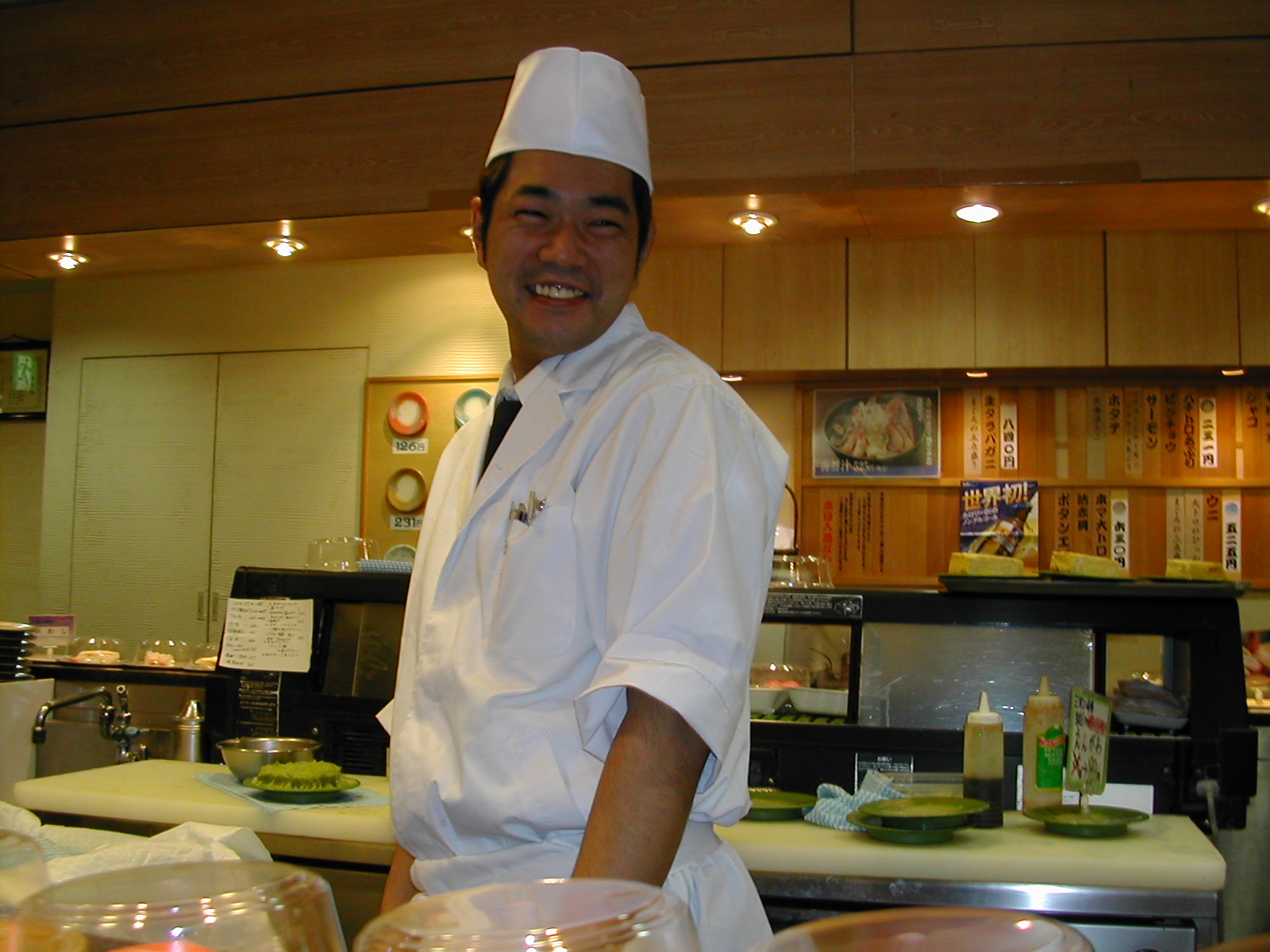
What a smile!
Ito-san makes sushi at the 6th floor of Cial which is at the west exit of the Yokohama Station. I was on the way to my Kana Shodo class, and I stopped by to have some sushi. While I was eating, an announcement started. It said the building would be gone next March, and they appreciate our patronage. I was upset.
"Why good and reasonably-priced restaurants in convenient locations disappear on me?!"
He was still smiling. I asked him about it. It sounded perhaps it would be rebuild with the Tokyu Hotel next door. He has worked at this place for eight years. The restaurant opened ten years ago. The name of the restaurant is Miura-Misaki-Ko.

A dish of live octopus.

The price of samma went down because it was no longer at the peak of the season. People would eat it broiled in November.

I showed my sensei my creative phrase after Lao-Zi"無為自然. It was 有為不自然, and my name in Chinese is Qi-Zi. In response,she wrote my work in red as a model for me to follow. 無為自然 means naturalness without any craftiness. So, I wrote 有為不自然. It means unnaturalness with craftiness. I showed my word to one of my Chinese teacher. He said it made sense. Great! Sometimes, when Japanese create a Chinese sentence, we are often wrong. I was right, and I was excited!
Subscribe to:
Posts (Atom)