I knew very little about Bose, an Indian activist who dedicated his life for India's Independence, but I didn't know there were two such activists with the same last name, Bose. Both men were in Japan, revered by Japanese, and died young. They were both cremated and buried in a temple in Japan.
http://en.wikipedia.org/wiki/Subhas_Chandra_Bose
http://en.wikipedia.org/wiki/Rash_Behari_Bose
It seems above English sites are the translation of the Japanese sites, and the Japanese sites show more references and little more details.
http://ja.wikipedia.org/wiki/%E3%82%B9%E3%83%90%E3%82%B9%E3%83%BB%E3%83%81%E3%83%A3%E3%83%B3%E3%83%89%E3%83%A9%E3%83%BB%E3%83%9C%E3%83%BC%E3%82%B9
http://ja.wikipedia.org/wiki/%E3%83%A9%E3%83%BC%E3%82%B9%E3%83%BB%E3%83%93%E3%83%8F%E3%83%BC%E3%83%AA%E3%83%BC%E3%83%BB%E3%83%9C%E3%83%BC%E3%82%B9
Showing posts with label India. Show all posts
Showing posts with label India. Show all posts
Sunday, February 23, 2014

Monday, April 18, 2011
Low and Long

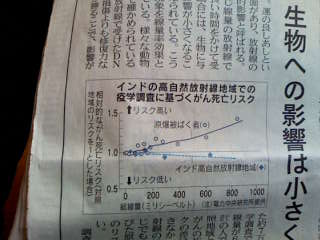
Nikkei newspaper of April 17 showed the above graph. The title is “The risk of cancer death based on an epidemiological research in the high radiation area in India.” I googled some erroneous spelling, but luckily, I found the following.
http://www.ncbi.nlm.nih.gov/pubmed/19066487
On the graph, the left vertical line shows risk, and in this case, the risk is set to 1. The bottom horizontal line shows the value in millisieverts. The longer they are exposed with low level of radiation, the risk is going down. Isn’t that interesting? I heard some part of Brazil and Iran has high background radiation, so I guess the situation must be similar. In the above web article, I found the words, terrestrial gamma radiation. Terrestrial sounds mysterious. It reminds of Ashok’s blog on Paspermia and Pansmeria. What we have under our lands are scary like faults, plates, and radioactive mineral but also fascinating.
According to Nikkei, in Karunagappally, Kerala, India, radioactive minerals are scattered in the area, and the average radiation there is 5 to 10 times more than the world average. The residents are exposed to the natural radiation of 10 to 20 millisieverts a year. In 2009, a study on 70,000 residents was conducted. The result was even the people who had accumulated over 600 millisieverts showed no evidence in the difference on risk when compared with a control group. For the same amount of radiation, if our exposure took a long period, then the effect on living thing would be smaller.
In recent weeks, I’ve gained quite many readers from Ukraine. I’m glad to see my blog statistic map turn green there. Now I know exactly where Ukraine is in the world map. I just want to say that I hear often Japanese scientists refer to what they’ve learned from the Chernobyl accident. Because the experts were able to accomplish many studies in Ukraine, the Japanese government quickly notified us about radiation when rained and the danger of pipe water for babies. They distributed bottled water to affected families. I appreciate the knowledge.
So, we know that exposing to enormously high radiation all at once or having accumulated over 100 millisieverts will increase the cancer risk. But what would happen if we were exposed to low radiation for a long period?
Nikkei newspaper of April 17 showed the above graph. The title is “The risk of cancer death based on an epidemiological research in the high radiation area in India.” I googled some erroneous spelling, but luckily, I found the following.
http://www.ncbi.nlm.nih.gov/pubmed/19066487
On the graph, the left vertical line shows risk, and in this case, the risk is set to 1. The bottom horizontal line shows the value in millisieverts. The longer they are exposed with low level of radiation, the risk is going down. Isn’t that interesting? I heard some part of Brazil and Iran has high background radiation, so I guess the situation must be similar. In the above web article, I found the words, terrestrial gamma radiation. Terrestrial sounds mysterious. It reminds of Ashok’s blog on Paspermia and Pansmeria. What we have under our lands are scary like faults, plates, and radioactive mineral but also fascinating.
According to Nikkei, in Karunagappally, Kerala, India, radioactive minerals are scattered in the area, and the average radiation there is 5 to 10 times more than the world average. The residents are exposed to the natural radiation of 10 to 20 millisieverts a year. In 2009, a study on 70,000 residents was conducted. The result was even the people who had accumulated over 600 millisieverts showed no evidence in the difference on risk when compared with a control group. For the same amount of radiation, if our exposure took a long period, then the effect on living thing would be smaller.
In recent weeks, I’ve gained quite many readers from Ukraine. I’m glad to see my blog statistic map turn green there. Now I know exactly where Ukraine is in the world map. I just want to say that I hear often Japanese scientists refer to what they’ve learned from the Chernobyl accident. Because the experts were able to accomplish many studies in Ukraine, the Japanese government quickly notified us about radiation when rained and the danger of pipe water for babies. They distributed bottled water to affected families. I appreciate the knowledge.
Subscribe to:
Posts (Atom)