
This is a blog about accents, but first, I want to show you the photos I forgot to show a few months ago. I went to Nezu Museum in Tokyo. The museum is famous for their collection of tea utensils and garden. The main building was remodelled recently. I prefer the way it was before, and the way they used to display. But like accents, even architecture and displays are changing. The new design leans more to western-style, I think. The above photo shows a tea house on top right.


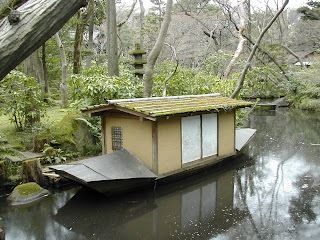
The photo above is a tea boat for two in the pond.
Anyway, this is a blog about accents. The other day I happened to find a blog written by Susan Brown of Red Room. Here is the site: http://www.redroom.com/blog/aninnymou/adios-arizonans,
and my comment follows.
Susan,
I enjoyed reading this post. It’s hilarious. But it’s true that we are all masters of our own language.
This afternoon, I was at the “Sakuragicho” station in Yokohama. When the tape ran for announcements in the car, I heard the same native Japanese speaker pronounced “Sakuragicho.” The speaker has a weird accent. This drives me nuts. A funny thing was that I noticed today that on the same tape, “Sakuragicho” in the English version was closer to the standard Japanese accent. It was ironic that the English speaker had an American accent.
From ministers to announcers on television, most of them, even though they were born in Tokyo or Yokohama, have accents. The other day, I went to listen to an amateur French-songs concert. All performers and audience were Japanese. And one woman was singing about “Wasi (Japanese rice paper).” I didn’t know why she was singing about Japanese rice paper. I thought it odd. Later, I read a pamphlet and found out that she was singing about eagle. They are both wasi with different accent. I told a friend of mine about it who went with me, but she was quiet about it. I think she didn’t notice. Japanese ears are trained not to notice differences in accents. That was a big issue a few years ago when I gathered a reading group for my play.
Anyway, the day after the concert, I talked with the organizer who is a friend of mine. She invited me to the event. I told her about the French song and pronunciation of wasi. She said she was busy, so she didn’t notice it, but that singer used to be a principal of a school.
After 35 years away from Japan, the language has changed so much. And whether I like it or not, if the majority sings “rice paper” to mean eagle, that’s the way it will be.


